|
A Simple Way to Promote Pulp Vitality and Patient Comfort
In the following case example, Dr. Kapish Goyal shares what makes BISCO’s TheraBase stand out in a crowded marketplace of bases and liners
 There are many liners and base materials on the market, many of which are glass ionomer or resin-modified glass ionomer materials. For me, BISCO’s TheraBase stands out in the crowd for several reasons. For starters, its application is simple and consists of a single step. It comes in a self-dispensing, automix syringe that eliminates potential errors stemmed from mixing with a precise proportion of base and catalyst. It also cuts down on procedure time. There are many liners and base materials on the market, many of which are glass ionomer or resin-modified glass ionomer materials. For me, BISCO’s TheraBase stands out in the crowd for several reasons. For starters, its application is simple and consists of a single step. It comes in a self-dispensing, automix syringe that eliminates potential errors stemmed from mixing with a precise proportion of base and catalyst. It also cuts down on procedure time.
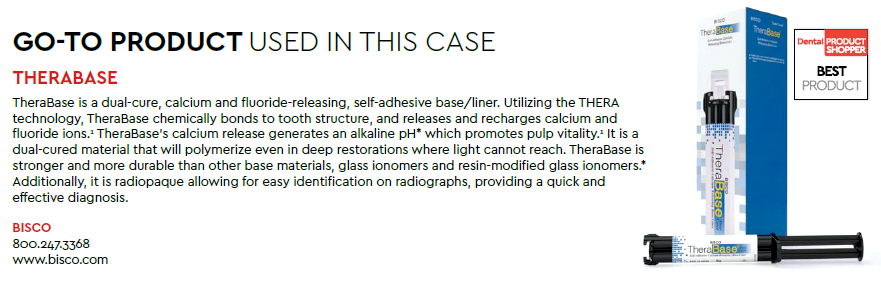
The self-adhesive material can fully cure even in deep restorations where light cannot reach, and it continuously releases fluoride and calcium ions* after bonding optimally to dentin thanks to the adhesion-promoting monomer MDP. It is radiopaque, which allows for easy visualization on radiographs, and its high strength allows it to be more fracture resistant and absorb occlusal shock better than other liners. Additionally, TheraBase produces an alkaline pH of about 11,* which promotes pulp vitality.1
Case in Point: Restoring Tooth No. 14
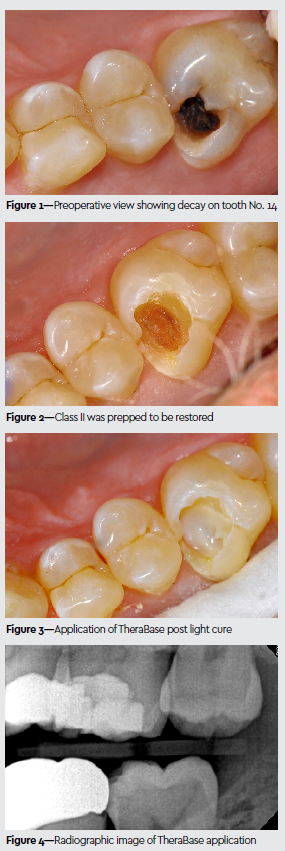
A 34-year-old man presented for a hygiene and exam appointment. Upon comprehensive exam and radiographic evaluation, a carious lesion was found on tooth No. 14. Due to the amount of decay present, we advised the patient that we would need to remove the decay in order to arrive at a more definite treatment plan, and that the tooth might need endodontic treatment and a possible core buildup and crown.
He was scheduled for a composite restoration on tooth No. 14. After decay removal, cleaning, and prepping, the lesion was found to be 1 to 2 mm directly above the pulp. A metal matrix band, wedge, and ring were placed. Proximal contact was burnished, rinsed, and dried, and 35% phosphoric acid was applied to the prep for 15 seconds, and then rinsed and dried.
TheraBase was applied to the dentin surfaces via an automix, immediate delivery syringe and light cured for 20 seconds. The 35% phosphoric acid was applied again for 15 seconds, rinsed, and dried. Multiple layers of a universal bonding agent were applied, lightly air-dried, and light cured for 15 seconds. A flowable composite was placed in 0.5-mm increments and light cured.
Finally, tooth No. 14 was restored with a bulk-fill composite in shade A2 and light cured for 20 seconds, multiple times. The restoration was light-cured twice after the matrix band and ring were removed. Occlusion was adjusted, the restoration was finished and polished, and contacts were flossed.
An Excellent Outcome
The patient was advised to return after two weeks to reevaluate for discomfort. On his return visit, tooth No. 14 was asymptomatic. No further treatment was needed, as the use of TheraBase during this restoration promoted pulp vitality as well as patient comfort.
References:
*Data on file. BISCO, Inc.
1. T. Okabe, M. Sakamoto, H. Takeuchi, K. Matsushima. Effects of pH on Mineralization Ability of Human Dental Pulp Cells. Journal of Endodontics. Volume 32, Number 3, March 2006.
|