



VibraJect R3 Anesthetic Injection System
ITL Dental
The VibraJect R3 greatly reduces or eliminates pain associated with anesthetic injection.
Techniques or devices that create vibration have been shown to inhibit painful sensations. 1 The VibraJect R3, from ITL Dental, is designed to block pain associated with all types of dental injections, including intraligamental, palatal, and blocks. Elimination or reduction of pain with the device is based on the gate control theory. The battery-operated motor attaches to a conventional syringe, causing the needle to vibrate, which, in turn, stimulates the nerve endings and blocks the transmission of pain to the brain.
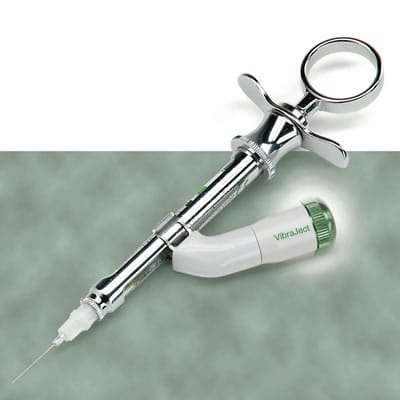
No special technique or topical anesthetic is required, and the 3-ounce unit attaches to conventional syringes (including intraligamental). The VibraJect R3 kit includes motor assembly, 3 autoclavable clip brackets, 2 batteries, and a recharging unit and power cord.
Patient Comfort
Fear of injections contributes significantly to postponement of dental treatment. The VibraJect R3 is intended for patients who experience pain during anesthetic injections; patients with a higher pain tolerance may not perceive a significant difference with the device. Because a patient’s pain threshold cannot be determined before an injection is administered, the manufacturer recommends that the system be used with all patients.
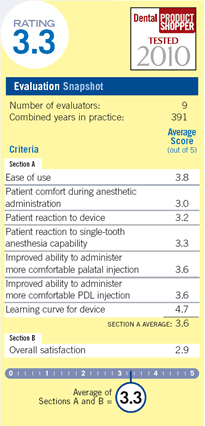
When the 9 dentists who evaluated the VibraJect R3 were asked about improved ability to administer more comfortable palatal injections, 3 rated it as excellent, 4 rated it as very good to good, and 2 rated it as fair. Improved ability to give PDLs was rated as excellent by 2 evaluators, as very good by 2, as good by 4, and as fair by 1. One dentist noted that the primary benefit “may be giving the patient the idea that you really are trying to avoid hurting them.”
Patient comfort during anesthetic administration was rated as very good by 3 evaluators, as good by 3, and as fair by 3. One evaluator said the majority of patients reported that “palatal and anterior maxilla injections were still as uncomfortable as conventional injections.” Three evaluators said their patients noticed the “slight buzzing” or “loud vibrations.” A dentist who “gives all 3 kinds of injections on a daily basis” said, “I happen to give a gentle needle, so most patients didn’t experience a vast difference.” One evaluator said patient reaction “varied greatly, from indifference to loving it.” One dentist noted that “some patients said it was very effective and some said it wasn’t… no negative comments.” Another evaluator reported that “most patients liked it,” and a sedation and cosmetic dentist who gives injections for many root canals and extractions said, “There was definitely improvement in pain relief.”
Ease of Use
After attaching the clip bracket and motor to a conventional syringe, the VibraJect R3’s motor is turned on with a twist of a knob. The clinician then uses normal injection technique to administer the anesthetic. The motor is easily removed from the clip bracket before autoclaving and can be wiped off with a surface disinfectant. The clip bracket can remain attached to the syringe during autoclaving.
Ease of use was rated as excellent by 1 evaluator, as very good by 6, and as good to fair by 2. One evaluator, an oral and maxillofacial surgeon, suggested “decreasing the angle of the VibraJect on the syringe so it’s more parallel to the syringe barrel, allowing you to rotate the syringe while in the mouth, if necessary.” A few of the evaluators noted that they would like the VibraJect R3 to attach more securely to the syringe. One evaluator noted that “clipping it onto my syringe, it would sometimes slide around.” A New York, NY dentist who owns and uses the original VibraJect found the new device to be difficult to turn on.
All of the evaluators who participated in this evaluation found the learning curve of the VibraJect R3 to be very short. Six evaluators rated the learning curve as excellent and 3 evaluators rated it as very good.
Overall Satisfaction
Overall satisfaction with the VibraJect R3 was rated as excellent by 1 evaluator, as very good to good by 4, as fair by 3, and as poor by 1. One evaluator said, “Most patients felt it made injections more comfortable and some felt it was distracting; they could focus on the vibration instead of the injection.”
Reference
1.Aminabadi NA, Farahani RM, Balayi Gajan E. The efficacy of distraction and counterstimulation in the reduction of pain reaction in intraoral injection by pediatric patients. J Contemp Dent Pract. 2009;9:33-40.