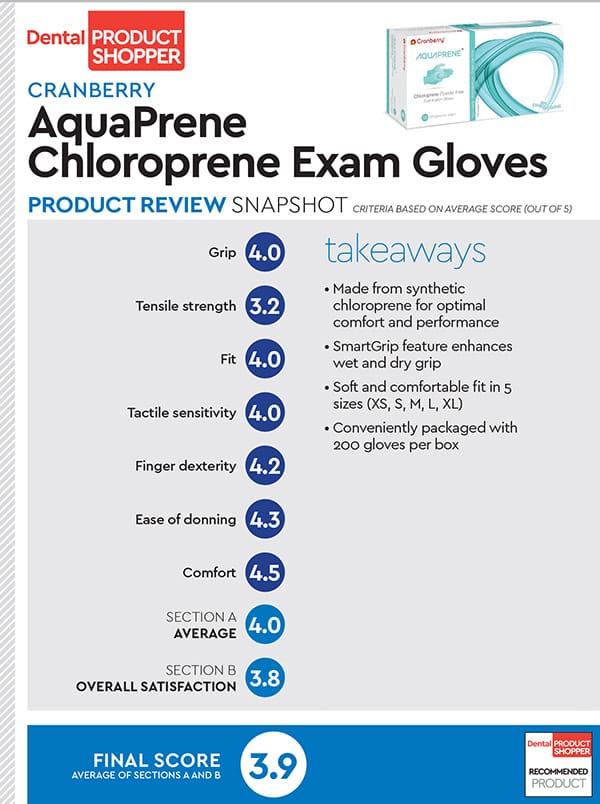





 Made from synthetic chloroprene, Cranberry’s AquaPrene Chloroprene Gloves combine the tensile strength, comfort, and sensation of latex with the elasticity of nitrile.
Exam gloves may not be glamorous or high tech, but you cannot practice dentistry without them. Gloves are absolutely essential for infection control to protect the patient and the clinician. But exam gloves need to be more than just strong and protective. Since most practitioners wear gloves for several hours a day, it’s crucial that they fit properly and comfortably, and remain flexible— all while allowing the clinician to safely grip instruments and maintain tactile sensitivity.
Made from synthetic chloroprene, Cranberry’s AquaPrene Chloroprene Exam Gloves combine the tensile strength, comfort, and sensation of latex with the elasticity of nitrile. For this Dental Product Shopper evaluation, several hygienists and dentists put these gloves to the test to determine if they lived up to their expectations.
Comfort and Fit
 In his past experience, Dr. Mariano Polack found nonlatex gloves to be uncomfortable and hard to fit. To solve this problem, Cranberry designed their ambidextrous AquaPrene Chloroprene gloves with the comfort and softness of latex while remaining elastic and form fitting. Dr. Polack was pleased that these gloves were “comfortable and easy to fit, even when hands were not completely dry.” Hygienist Jenna Hebert agreed and said, “The glove itself was very comfortable to get on; it had proper room in the length of the fingers.”
Dr. Sherwood Tucker called the gloves softer and more comfortable, and Robin Greenberg said everyone in her office liked the fit and feel. Sherry Morrissey commented, “This glove had a different material, compared to nitrile gloves. It was softer and kept my hands drier.” Dr. Jay Stone appreciated that there are 200 gloves per box, adding, “Seemed like it took forever to empty a box.”
Available in 5 sizes (XS, S, M, L, and XL), the dental exam gloves “fit and feel great,” according to Teresa Ventrella, and Dana Jones, RDH said, “The gloves did not pull around the thumb index area” as with some other gloves. Dr. Tim Fagan recommended a wider selection of sizes, and Dr. Rebecca Hartfield, who has small hands and long fingers and normally wears a size small, found these gloves to be tight in the finger width and loose at the fingertip.
Ease of Donning and Strength
According to Cranberry, this glove is strong and flexible, and will stretch without tearing. “[The gloves are] easy to put on and take off, [and] they are easy to remove from the box,” shared Dr. Robert Holtzheimer, who said his favorite features were the strength and durability. Dr. Stone said they do not tear, even when he caught his finger tip with a spinning bur. Ventrella remarked, “The gloves seem to be thinner yet just as durable.” A few evaluators commented on the gloves’ thinness. Dr. Tucker said, “Everything was excellent except they seemed to tear easier,” and Jones said the gloves sometimes punctured around her ring.
Dr. Stone said the dental exam gloves “go on very easily, even with slightly damp hands,” and Dr. Fagan called them “easy to put on and comfortable to work in,” adding, “With the FDA ban of powdered gloves, [I was] looking for a glove that goes on easily.” Dr. Polack, who said he has found that nonlatex gloves are difficult to put on, was pleasantly surprised at how easily these gloves came on and off. He would like to learn more about their thickness and safety as a barrier, compared to other latex and vinyl gloves.
Grip and Tactile Sensitivity
AquaPrene’s SmartGrip feature enhances wet and dry grip, and allows for excellent tactile sensitivity, according to Cranberry. While some gloves cause instruments to feel slippery, Sherman said these “had a pretty good grip” and did not feel slippery, which made her more confident holding the instrument. Dr. Polack said the gloves offered the same grip as his regular latex gloves, and Dr. Fagan praised their texture. Morrison said they were thinner and more flexible than her previous nitrile gloves.
Dr. Holtzheimer revealed that AquaPrene had tactile sensitivity better than any other glove, and Morrison said her tactile sense seemed better. Dr. Robert Gurmankin also lauded the tactile sensitivity and flexibility, and added that he would recommend these chloroprene gloves to colleagues who need a nonlatex glove with better tactile feel than nitrile.
Overall Satisfaction
“I was so excited to try these gloves as another option instead of vinyl, [and] I was happy to see they fit so comfortably,” said Hebert, who added that she was a bit concerned with the lack of strength and durability. Dr. Holtzheimer said he “really liked these gloves from the first wearing until the last.” Ventrella appreciated these new gloves more than those her practice had been using, and added, “We are switching our hygiene gloves to this brand.”