


Saving the tooth—the goal of modern-day endodontic treatment—has evolved considerably in recent years, with clinicians benefiting from a steady stream of advancements in root canal sealers. And Dentsply Sirona’s recent rollout of 2 clinically proven sealer brands fits that definition perfectly.
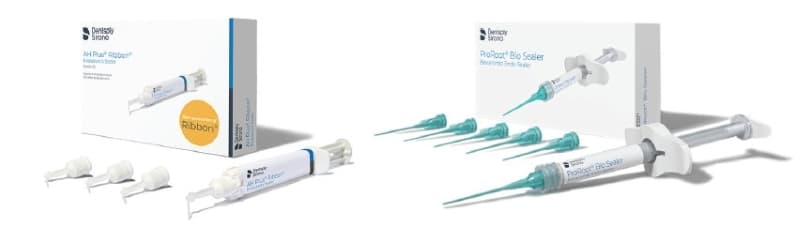
AH Plus Ribbon Sealer
Building on decades of clinical success and more than 800 million root canal fillings with the AH Plus product family, AH Plus Ribbon represents the next generation of resin-based sealer technology.
Next to excellent long-term sealing properties and significantly lower short- and long-term leakage profiles when compared to bioceramic sealers,1 the sealer demonstrates outstanding adhesion to gutta-percha2 and dentin, reinforcing the integrity of the seal, and is the perfect interface between those 2 surfaces.
“The flowability is better with the altered consistency,” said Beth Damas, DDS, MS, in Orland Park, IL. “Lots of lateral canals were hit with this version.”
Designed for both cold and warm obturation techniques,³ AH Plus Ribbon is especially efficient for single-cone workfl ows, a benefit for clinicians who might be skeptical about using a resin-based sealer.
ProRoot Bio Sealer
Ideal for those who prefer a resin-free, bioactive sealer, ProRoot Bio Sealer’s calcium silicate-based formulation features higher bioactive cement content compared to other bioceramic sealers, which promotes hydroxyapatite formation and ensures a high pH value.⁵ It offers a high short-term healing rate and more stable radiographic visibility over time compared to leading bioceramic sealers.⁶
With a nonstaining formula,** ProRoot Bio Sealer promotes trouble-free handling, is easy to retreat,7 and works with all obturation techniques.⁸ An adaptable Flex Tip design offers precise application into canal anatomies, with up to 49% less waste per tip.⁹
References
1. In-vitro study based on the “Fluid Filtration Model,” Gustavo De-Deus. Data on file. Method according to De-Deus et al., J of Endodontics. 2008; 34(3):322–5.
2. In-vitro study based on Micro Shear Bond Strength, Gustavo De-Deus. Data on file. Method according to Gustavo De-Deus et al., Int Endod J. 2021; 54:1653–1658.*
3. Dimensional stability comparison testing was conducted according to the test method in ADA#57 R2012 5.8, with adapted acceptance criteria.*
4. Based on crystalline portion evaluated by XRD analysis comparing different bioceramic sealers.*
5. In vitro pH study, demonstrated pH level of up to 11.*
6. Randomized controlled ongoing clinical trial (>450 follow-up cases) comparing bioceramic sealers with AH Plus resin-based sealer. Gustavo De-Deus, University of Rio de Janeiro.*
7. Carrillo, et al. Retrievability of calcium silicate-based root canal sealers during retreatment: an ex vivo study. J of Endodontics. 2022; 48(6):781–786.
8. In vivo case study comparing handling of bioceramic sealers using warm obturation technique, Walsh.*
9. Tip waste analysis of different bioceramic sealer tips.
** Internal/external data on file. For more information, contact Consumables-Data-Requests@dentsplysirona.com.
** Does not contain bismuth oxide, which is responsible for staining.