
At its third annual summit, DentiMax launched its Frame imaging software and rebuilt Flow’s voice charting around how clinicians actually work
“We tried to really pack in as many features as we could while also keeping it simple,” Ross said. “We know a lot of people will get overwhelmed if there’s too much on a screen at one time.” Frame is currently server-based, with a cloud version planned for 2027.
Going with the Flow
After 20 years of providing server-based software, DentiMax launched Flow, its cloud-based practice management platform, at the company’s first summit in 2024.
"We wanted to create a system that was accessible, scalable, easy to use, affordable, and technology-forward,” Dieujuste said. Each year since, the platform has added new features.
The 2024 launch included built-in online scheduling, texting, patient registration, intraoffice messaging, custom forms, KPI tracking, and digital signatures. In 2025, DentiMax added clinical note signing, missing note analytics, a ledger search function, an unscheduled treatment plan screen, integrated credit card processing, and e-prescribing through DrFirst, along with voice-activated perio charting.
However, that last feature had room to grow, Dieujuste said. After a video of last year’s version played, a hygienist with 25 years of experience who charts with Flow noted the difference. “I use it on my phone, and it can go so much faster now,” she said.
“So, this year we decided we were going to level up our game and actually make the voice perio usable for somebody like [her],” Dieujuste said.
The rebuilt, AI-powered version listens to a normal conversation and picks out charting commands, so a hygienist can talk with a patient and chart at the same time. It recognizes keywords from a built-in library, and if a practice uses terms the library doesn’t include, staff can add them to the service code list, so the software learns them going forward. One attendee explained how her practice uses its own patient-friendly name for scaling and root planing, and now the software learns that wording.
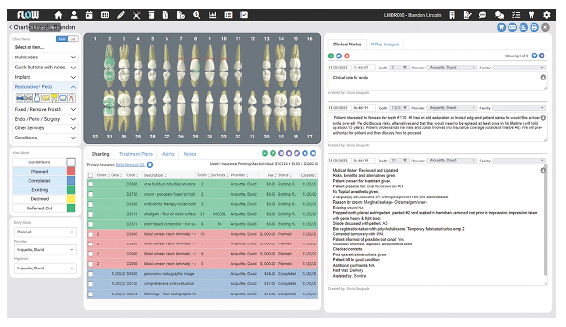
Voice control also extends to clinical notes and comprehensive exam charting. During a live demo, Dieujuste treatment-planned extractions on teeth Nos. 32 and 17 by voice. “That’s probably faster than your assistant can find the button,” she said.
Other 2026 features aim to cut admin work: online payments that post automatically to patient balances, automated post-appointment review requests, and automated claim remarks and attachments. Patients can also upload their insurance and ID cards ahead of time, so the practice has them before the visit.
Still to come is a 3D oral model, currently in beta, that lets clinicians rotate and zoom a view of the patient’s charted restorations. More voice tools and support for other languages are also on the way.
The Bigger Picture
“The best technology is the kind you stop noticing,” said David Arnett, president and cofounder of DentiMax. “The practice just runs better, and the team gets its day back.”
With each of its products, DentiMax aims to do exactly that by simplifying workflows and helping dental teams work more efficiently.