


A Modern Roadmap to Implant Mastery

Author
By: Dental Product Shopper
2/27/2026

Just how far can implant placement take your practice? With the right education, tools, and support, clinicians at any stage of their career can build the competence and confidence required for implant success.
JanFeb26_Feature_MainImage.png

Starting something new can be scary—it’s hard not to dwell on the challenges ahead or how much can go wrong along the way. But often, the rewards make the risks worthwhile. This is certainly true when it comes to learning implant dentistry.  


Becoming proficient at implant placement can not only transform a dentist’s professional trajectory but also allow them to provide patients with a uniquely life-changing service. And though few would describe the implant journey as “easy,” the current landscape is marked with discoveries and developments that make success more achievable than ever before.


Implants Through the Years

With 18 years in practice, Serv S. Wahan, DMD, MD, has had a front-row seat to implant dentistry's incredible evolution. Now a board-certified oral and maxillofacial surgeon based in Seattle, WA, he reflects on how different the technologies and techniques were during medical school and while completing his surgical residency.


"We only had 2D imaging, so many times, we’d just put the implant where the bone was,” Dr. Wahan recalled. He and his fellow residents received relatively little practical experience with implants, completing just 30 to 40 cases during the 6-year residency program. That said, even by today’s standards, most implant training happens while on the job. “It sounds kind of scary, but that’s just how it is,” he said.


See More in Lifelike 3D

Still, diving into implant dentistry isn’t nearly as daunting as it used to be. For one, modern practitioners have a safety net in cone beam computed tomography (CBCT), which captures patient anatomy in lifelike 3D.


When Dr. Wahan’s practice acquired its first CBCT unit 15 years ago, it brought a new level of precision and predictability to his implant workflow, even when paired with the “rudimentary” software of the time. “Now, a CBCT scan is the gold standard,” he said. “It’s unheard of to do an implant case without one.”


Technology + Social Media = Accessibility

Modern technology has also made implant education more accessible than ever. “Between courses, videos, podcasts, and social media, there are now a ton of quality resources out there,” Dr. Wahan explained. Many clinicians who create educational content online are more than happy to share their expertise—a fact Dr. Wahan can personally attest to. During the pandemic, he began showcasing his work on social media and quickly discovered it was a fun and effective way to learn and teach. Since then, he’s built a sizable following and now regularly interviews fellow dentists on his popular video podcast, The Dr. Wahan Experiment.


“I get messages from doctors daily,” he shared. “It’s a really convenient way for people to connect and get a lot of information for free.”


Finding What Works

Today’s digital systems play an increasingly important role in diagnosis and implant planning. As Dr. Wahan noted, tools like CBCT, intraoral scanning, and 3D printing are also reshaping surgical workflows.


“When I first started placing implants, it was entirely freehand, but then everything shifted to fully guided surgery,” Dr. Wahan explained. While he recommends every clinician learn freehand technique, custom surgical guides can turn otherwise-complex procedures into simpler, more streamlined processes. That said, fully guided isn’t necessarily the right fit for every case. “There’s a cost for all those parts and pieces, and there also are complications,” he noted, adding that in many cases, using a guide at every step can be “overkill.”


These days, Dr. Wahan has found that a 3D-printed pilot-drill guide is usually all he needs.


“We have a protocol now where we send our scans to a dental lab that plans cases for us. Once we finalize the plan, the lab will make us the guide with a very quick turnaround.”


Though this system is perfect for Dr. Wahan’s practice, there’s no one-size-fits-all solution for success. “Having 4 offices, it just makes sense to centralize that workflow in one location,” he said. “However, a lot of doctors print their own guides in-office, and that works really well, too.”


The lesson? Implant dentistry leaves ample room for experimentation.


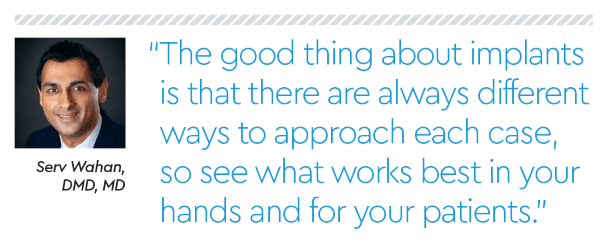
“Try different instruments; do surgery freehand, do it guided,” he said. “The good thing about implants is that there are always different ways to approach each case, so see what works best in your hands and for your patients.”

JanFeb26_Feature_WahanQuote.png

Partnering for Success

Selecting the right implant system is another key to success, and today, there are myriad products to choose from. While Dr. Wahan’s practice leverages implants from several manufacturers, Nobel Biocare has emerged as a standout partner.


“I find that NobelActive and NobelParallel conical connection implants work best for almost all my full-arch cases,” he reported, adding that the company’s long history of expertise is evident in the quality and variety of implant components and biologics it offers.


Dr. Wahan also appreciates Nobel Biocare's TiUltra surface technology, which promotes early osseointegration and minimizes issues like peri-mucositis and peri-implantitis over time.


“With this smooth, anodized surface, you effectively get a bone-level implant that mimics the long-term performance of a tissue-level implant without compromising esthetics,” he explained.


In Dr. Wahan’s experience, all today’s top implant companies offer great products, but support is what distinguishes a partner from a provider. “It's the reps on the ground who make a big difference,” he affirmed. “Our Nobel Biocare reps come in for cases, troubleshoot referrals, and help connect us with our local lab. And when new technology comes out, they’ll walk us through it as many times as we need—with 4 locations and 5 surgeons, that’s a lot of time dedicated to our practice.”


A Lifelong Journey

Even with all the advantages doctors have today, success in implant dentistry ultimately comes down to one thing: a lifelong commitment to continuous growth. Like any master of their craft, Dr. Wahan maintains the open, curious mindset of a student.


With nearly 2 decades of experience and countless surgeries under his belt, he’s still seeking better ways to serve his patients.


“Innovation is an inherent part of our practice, and things change quite frequently,” he said, sharing that he recently completed a cadaver course on zygomatic implants.


The implant journey never ends. Whether you’re just starting out or you’re well on your way, in the words of Dr. Wahan, “You’re always going to be learning.” Fortunately, it’s never been easier to plot your personal path to success.