During direct restorative procedures, matching the exact shade of a natural tooth with a composite can be challenging, especially in anterior restorations. To reproduce the color and translucency of the surrounding tooth structure, dentists often rely on layering multiple composite shades.
Although effective, composite layering can be technique-sensitive and time-consuming; it often requires maintaining a large inventory. In addition, even minor variations in shade selection or layer thickness can compromise the esthetic outcome.
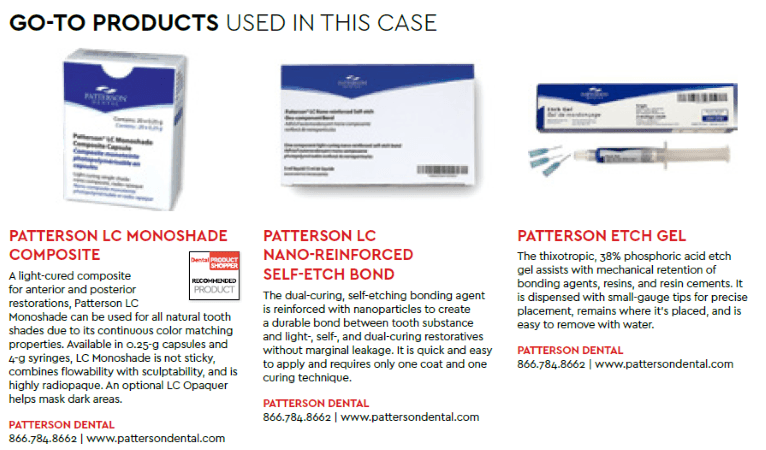
Patterson LC Monoshade Composite offers a practical solution to this challenge because its chameleon effect blends seamlessly with surrounding tooth structure. Available in 4-g syringes and 0.25-g capsules, Patterson LC Monoshade simplifies shade matching without requiring multiple shades or complex layering techniques.
This case demonstrates how Patterson LC Monoshade streamlines the restorative workflow and delivers predictable, esthetic results while reducing chair time, technique sensitivity, and composite inventory requirements.
Patient Presentation and Treatment Plan
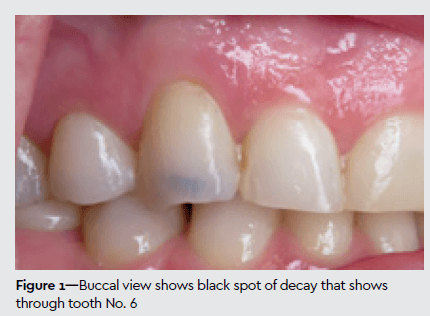
A 53-year-old woman presented to our clinic with a chief complaint of a chipped upper right canine and a black spot visible inside the tooth.
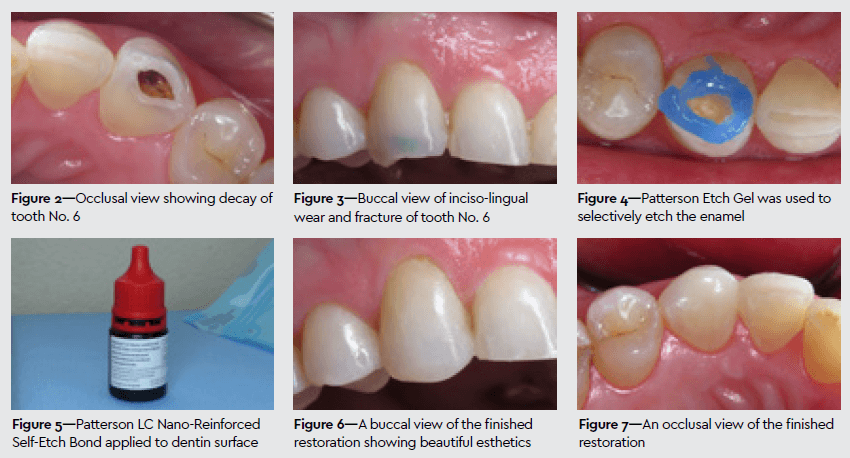
The clinical evaluation revealed decay on tooth No. 6 (Figures 1-2), as well as inciso-lingual wear and fracture (Figure 3). A treatment plan was designed to restore the tooth using Patterson LC Monoshade.
Preparation, Etching, and Bonding
The patient was anesthetized with a local anesthetic, 3% Carbocaine Plain. The tooth was prepared using both high- and low-speed burs to remove decay, establish healthy preparation walls, and bevel the enamel for retention and esthetics.
To assist in retention, the enamel was selectively etched with Patterson Etch Gel for 15 seconds (Figure 4). The etch gel was then rinsed away, and the tooth was gently air-dried without desiccating the dentin. Next, a dual-curing, self-etching bonding agent, Patterson LC Nano-Reinforced Self-Etch Bond (Figure 5), was applied to the dentin for 20 seconds, air-dried for 5 seconds, and light-cured for 10 seconds.
Final Esthetics with LC Monoshade
A capsule of Patterson LC Monoshade was loaded into a standard dispensing gun, and the composite was applied in 2 increments. Each layer was burnished, adapted, and light-cured for 20 seconds. After adjusting the occlusion and incisal length, the restoration was polished to a high shine using composite polishers.
The final restoration revealed that Patterson LC Monoshade achieved beautiful esthetic harmony on all surfaces (Figures 6-7). The patient was highly satisfied with the results.