

Atraumatic Extractions, One Twist at a Time

Author
By: Dental Product Shopper
9/1/2026

Inventor David Fyffe, DDS, tells DPS how Xpanders make tooth extraction more predictable and atraumatic, while Dr. Ross Isbell reveals how the instruments hold up in practice
 

xpandersaugdig00.png

David Fyffe, DDS, asks other dentists to imagine a patient’s tooth as a for sale sign stuck in their front yard. Removing that sign requires more than one dimension of movement, and that’s what’s needed when extracting a tooth.


“You don’t just walk up to the for sale sign and move it back and forth,” he explained. “You move it side to side and front to back. And that’s what you want when extracting a tooth. You want to move the tooth mesially and distally as well as buccally and lingually.” Dr. Fyffe had struggled for years with elevators and luxators during extractions when it occurred to him that with some minor adjustments, he could create an instrument that would allow for that dynamic movement and result in a better experience for dentists and patients. Enter Xpanders.


Uniquely Designed


Dr. Fyffe’s Xpanders prototype began its life as an elevator. First, he put pencil to paper to sketch out what he envisioned and then put that elevator on the lathe in his lab to create the preliminary design. “What I found was that most of the thinner instruments don’t allow you to get a lot of tooth movement,” said Dr. Fyffe. “But with the Xpanders, I found that when you twisted the instrument, it really moved the tooth laterally, sort of like a crowbar.”


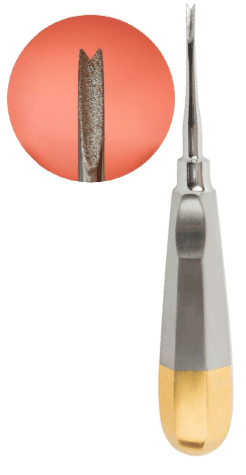
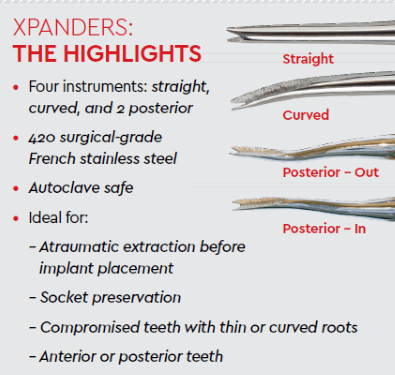
With a double prong and diamond grip, clinicians can create a stable 2-point contact between the bone crest and tooth neck. Then, with a bit of a twist, 1 point connects onto the bone while the other pushes the tooth laterally. That movement leads to bucco-lingual socket expansion and loosening before going in with a forceps. Xpanders can be used in the anterior or posterior. A set of 4 instruments includes 1 straight, 1 curved, and 2 posterior.


Ross Isbell, DMD, MBA, has experience with Xpanders. The Alabama clinician describes them as similar in handling and direction of force to a luxator or PDL knife, “but significantly stronger. The 2-pronged tip allows for similar access into the PDL space to a luxator but better than a standard elevator, while still maintaining the strength of an elevator for torque forces.”


Predictably Efficient


Both dentists and their patients want an extraction experience that’s predictable, efficient, and as atraumatic as possible. Dr. Fyffe describes Xpanders as enabling predictable extractions. “The problem with forceps,” Dr. Fyffe said, “is that a lot of times, they’ll break the root tip off. That’s a bad experience for the patient and the dentist because now the whole procedure will take a lot longer. Ultimately, there’s more prying and pushing. With Xpanders, you get the tooth super loose…which makes the experience a lot less physically and psychologically traumatic for the patient. They don’t have to deal   a broken root or extreme tugging and pulling.”

xpandersaugdig01.png

Dr. Isbell described Xpanders as time-saving instruments. “I often use Xpanders in place of a luxator or small elevator, so it reduces time in situations where I otherwise would need to reach for a handpiece to create access,” he said. “Xpanders are very useful in helping me complete broken or equigingival root extractions more effectively.”


“I have a wide range of instruments for specific situations and am thankful for having choices,” Dr. Isbell continued. “But the Xpanders are one of the few [instruments] that function as a hybrid between a few different categories of instruments. Being able to have a small but highly functional set of instruments packaged together for your initial approach to any case can help your team prepare for the day more efficiently.”


Delivering on a Promise


Tooth extraction can create stress for patients. Having an instrument like Xpanders at the ready offers dentists an opportunity to put patients’ minds at ease. As Dr. Isbell described, “When your patient arrives with a tooth buried below the gums and says, ‘I don’t know how you’re going to get this out,’ it’s nice to confidently respond, ‘I got this.’ Being able to deliver on that promise with a single instrument is very satisfying.”


Go to artcraftdental.com/products/xpanders to learn more and see Xpanders in action.