


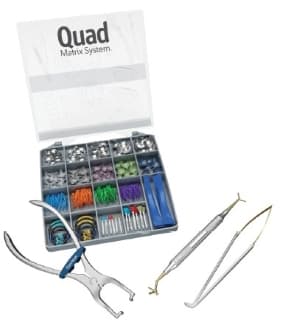
Category Spotlight: Quad Matrix System

Author
By: Bryan Gillis
2/10/2026
quadmatbg00.jpg

The Quad Matrix System was created through a collaboration between Garrison Dental and Dr. Matt Burton to solve one of the most persistent challenges in Class II dentistry: predictably restoring back-to-backs and deep margins. Built on thousands of hours of clinical validation, the system integrates materials and techniques that work together to simplify complex posterior composites.


Every component of the system is designed to address the realities of difficult Class IIs. The drawn-wire nickel-titanium rings deliver lasting separation, but the real advantage comes from how the right- and left-sided driver tips reach deeper into the embrasure. This creates the displacement needed for tighter contacts in back-to-backs while maintaining stability. The asymmetrical Soft-Face tip reduces flash and supports ring placement when working around uneven or complex geometries.


The split-tip Quad Wedges complement the driver tip. Each half supports the cervical margin independently, helping it adapt to mismatched depths on both sides of the interproximal space. As the wedge glides alongside the papilla, it seats deeper into the sulcus, improving cervical sealing below deeper preps while maintaining a natural emergence profile.

quadmatbg01.jpg

Taking on Complex Cases


For back-to-backs, the system is designed to act as a unified solution. Using 2 bands, 1 Quad Wedge, and 1 Quad Ring, clinicians can complete both restorations simultaneously. The coordinated interaction between the driver tip and split wedge ensures pre-dictable tooth separation for tighter contacts while independently reinforcing each cervical margin.


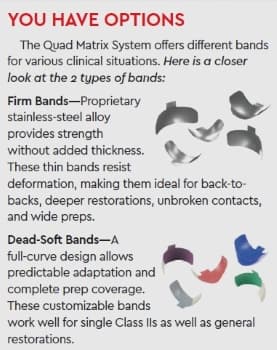
For multitooth or deeper restorations, universal and tall Quad Rings can be stacked to achieve proper contours and contacts. The Firm Band and Quad Wedge support deep preparations, and the driver tip further secures the seal.


While effective for standard Class IIs, this system shines in complex posterior cases. By improving control in deep margins, reinforcing cervical adaptation, and simplifying back-to-backs, it allows dentists to complete direct restorations efficiently for better outcomes and an improved patient experience.