


Cracking the Code to Confident Diagnosis

Author
By: Dental Product Shopper
2/12/2026

The missing link in modern diagnostics, InnerView identifies tooth movement associated with cracks and loose restorations long before symptoms or visual signs appear—paving a clear path toward early treatment intervention
 

innerdig00.jpg

When a general dentist referred a patient to Bao-Thy N. Grant, DDS, a board-certified oral and maxillofacial surgeon in Orange, CA, the concern was that a dental implant placed 14 years earlier was now failing. The referral asked Dr. Grant to take a closer look and be prepared to remove the dental implant if necessary.


Using traditional methodologies, she tested the tooth and found evidence of mobility on the crown vs peri-implantitis on the dental implant. Dr. Grant, who is regarded as a trailblazer in robotic-guided surgery and an early adopter of artificial intelligence (AI), elected to take her diagnosis a step further and determine the actual cause of mobility before removing the entire dental implant. So, she reached for InnerView.


See What Can’t Be ‘Seen’


“When I examined the CBCT of this patient, I found the crestal bone level to be very favorable and couldn’t see anything of concern,” Dr. Grant shared. “After testing the patient with InnerView, I saw that we had very low mobility scores, which gave me a snapshot of what was going on with the bone. However, of concern was that we had a very high Normal Fit Error (NFE) score, which is a key algorithm in the QPD system. It told me there was something occurring structurally,” she explained.


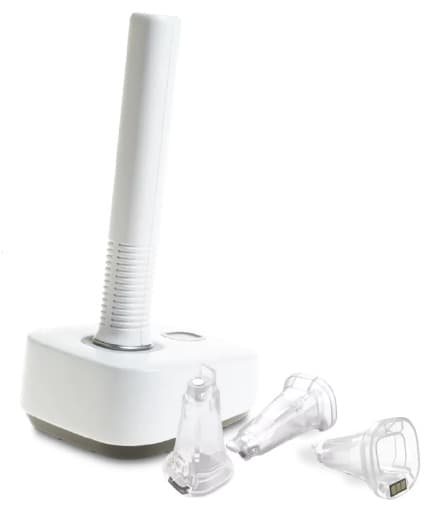
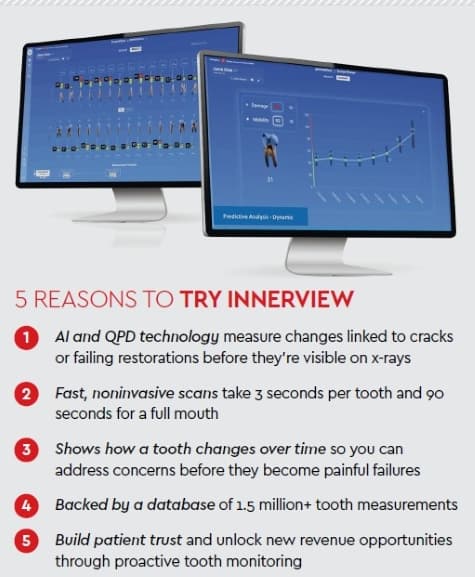
The first-ever FDA-cleared technology for measuring internal mobility in teeth—a situation commonly associated with loose restorations and cracks—InnerView is a noninvasive device that offers clinicians objective insight into what can’t be seen visually nor with imaging technologies or radiographs. With just a 3-second scan per tooth, InnerView detects structural changes inside the tooth long before symptoms or visible signs appear. It does this by leveraging AI to power Quantitative Percussion Diagnostics (QPD), which converts gentle percussive taps into measurable data on tooth structure. The handheld device gives clinicians like Dr. Grant a window into early structural changes, failing restorations, and dental implant instability, allowing them to make more informed diagnostic decisions.


“It doesn’t tell me exactly what is going on, but it does tell me, ‘Hey, take a closer look.’ It’s an internal snapshot of what’s happening with the tooth or the dental implant," she advised.


Dr. Grant removed the crown and reordered the internal screw, which she suspected might be loose or broken.


“When I accessed the structure, the internal screw, which is the connection between the crown and the dental implant, was very loose and at the verge of a fracture,” shared Dr. Grant. “We then placed a healing abutment and used InnerView to test again to ensure the mobility score of the dental implant. Our numbers were extremely favorable!”


And with that, Dr. Grant, her staff, and her patient collectively breathed a sigh of relief, knowing that the dental implant did not have to be removed and that the patient was spared from another complex surgical procedure.


Dental Implant Failure Averted


“The data from InnerView and my resulting treatment plan allowed us to act quickly to prevent an internal screw from fracturing, which would have led to dental implant failure,” Dr. Grant added. “InnerView gives me a quantitative value and an energy return graph that allows me to tell my patients a story about what’s going on with their tooth structurally—a story that I can't always see radiographically or clinically with my eyes, hands, and instruments. I think that bridging this gap has provided a tremendous value for my patients."

innerdig01.jpg

“This case illustrates how we can use InnerView to begin treating patients with more preventive and reparative work, rather than moving quickly toward treatment that will be more catastrophic for the patient—in this case, an entire dental implant replacement,” she continued.


Having long been a proponent of using innovative dental technology, Dr. Grant has seen firsthand the positive impact that AI-driven tools have on her ability to offer the highest level of excellence to her patients.


“When I adopt technology, I ask myself several questions,” she shared. “First, will it enhance the way I diagnose a treatment plan? Will the technology enhance the patient’s safety? And finally, will it enhance the treatment outcome? And if the answer to those questions is ‘yes,’ then why wouldn’t a clinician adopt that technology?”


Using Technology for Good


While the benefits of a technology like Innerview to the patient experience are clear, Dr. Grant notes that as AI-driven tools become more accessible, their role is to support—not replace—clinical judgment, with patient care remaining the primary focus.


“Data from technology such as InnerView educates us and our patients. In the end, it’s all about doing what’s right,” she said. "As a member of the dental community, I have a duty to positively influence and impact our profession amidst the rapid ascent of technology."


She believes the challenge facing dentistry today is for clinicians to stay relevant, innovative, and deliver an ethical, scientifically driven, and technologically advanced service that is not only grounded in good data but driven by a strong moral compass.


“If I can merge my clinical skills with AI-powered data that tells me what can’t be detected by traditional imaging, I can be more confident in my diagnosis,” Dr. Grant explained. “I believe my patients, who can see the results as well, feel more nurtured and involved in the diagnosing and treatment planning. And it solidifies the fact that they are making an informed consent.”

Shop Now