

|
MICHAEL C.
Dr. Verber serves as the CEO and Chairman of the Verber Dental Group, which consists of over a dozen family, pediatric, and specialty practices in the Camp Hill, PA, area. In addition to treating patients locally, Dr. Verber is a nationally recognized teacher and dental entrepreneur.
BRETT MAYS, CDT Brett Mays is the |
Custom Direct
Implant Direct's Custom Direct service provides easy,
|
|
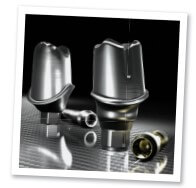
Every implant patient you treat has varying dental goals and challenges. That’s why the foundation of an implant restoration—the abutment—should be designed to meet each patient’s unique functional and esthetic needs. Implant Direct’s Custom Direct service allows practices to do just that by providing precise, patient-specific abutments using an easy digital workflow. Custom Direct users for the past 4 years, Verber Dental Group's Michael C. Verber, DMD, FICOI, and Brett Mays, CDT, weigh in on their experience.
Can you briefly take us through how the Custom Direct process works? Brett Mays: Using an intraoral scanner, we scan patients with an Implant Direct scan body in place, which communicates the size and position of the implant. The scan gets imported into a 3Shape dental design program where the custom abutment is designed. Our lab tech designs the abutment and the crown at the same time, while also verifying tissue health. Once finished, the design is sent to Custom Direct for milling.
Why is the Custom Direct service such an asset to your implant workflow? Dr. Verber: The key element is control over the design process. We take photos, digital impressions, and a CBCT to make a digital wax-up that will meet both esthetic and functional goals. With a “crown down” approach, our surgeons can do virtual surgery and produce surgical guides. We want to control the size, shape, and position of our restorations, and we can do that from start to finish with the Custom Direct service.
Brett Mays: The digital solutions offered by Custom Direct make designing and sending custom abutments easy and predictable. The platform sizes are color coded for simple identification and ordering. While the design step can be delegated to skilled Implant Direct technicians, we enjoy the ability to design our abutments in-house. With other companies, you give up control over the design of your patient-specific abutment, which means you may be sacrificing the quality of the final restoration.
In your restorative workflow, which specific patient treatments benefit most from using Custom Direct? Dr. Verber: We use Custom Direct abutments for all single-unit implant restorations and all cement-retained bridges. We use the “screwmentable” approach, which gives our single-unit crown patients the advantages of both screwretained and cement-retained restorations. Our practice partner, VerTrue Dental Lab, delivers the restoration to the doctor as a 2-piece Custom Direct abutment and a crown with an access hole. The doctor then seats the abutment and is able to try-in and adjust the crown knowing that the abutment is completely seated without interference from a path of insertion issue. We then remove the abutment so that cementation can be done outside the mouth, which eliminates excess cement in the sulcus. With Custom Direct, we can control margin position, restoration thickness, material selection, and emergence profile—all while delivering the strongest possible restoration.
What sets Custom Direct apart from similar implant system providers? Dr. Verber: I have used dozens of other systems over 20 years, and for me, it comes down to quality. Implant Direct was founded on quality manufacturing principles, and that legacy continues today. They have the ISO certification and track record to give us complete confidence and the ability to match OEM restorative components with high-quality implants. |


Shop Now