



A senior director at Ultradent explains why slow-releasing fluoride varnish with staying power is the best way to maximize fluoride uptake for demineralized and sound enamel
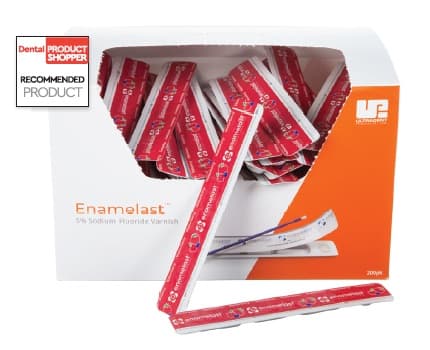
Fast-acting fluoride varnishes have caught on in recent years, as clinicians look to repair demineralized enamel with minimal disruption to patients. But there's a catch: Demineralized enamel absorbs fluoride readily, while denser, healthy enamel takes it up far more slowly. This means that some varnishes don't linger on sound enamel long enough to strengthen and protect it.
Ultradent's Enamelast rethinks that trade-off. Studies show that the longer fluoride stays in contact with teeth, the more both demineralized and sound enamel absorb it, said Andy Kawamoto, Senior Director, Research & Development, Chemical & Biological, at Ultradent. The company stands behind the science, with Enamelast formulated to stay on enamel as long as possible, maximizing uptake.
New Data, Same Proven Uptake
Ultradent recently completed third-party laboratory testing that supports this. Fluoride uptake from various varnishes was measured in sound enamel at 4 and 12 hours after application. Enamelast achieved the greatest uptake in both tests.
"Fluoride’s effect on teeth hasn’t changed,” Kawamoto explained. “If you want the full benefits of the modern model for caries management, fluoride needs to remain in contact with the tooth surface for as long as possible.” That means offering flavors that appeal to patients. Ultradent recently added 2—Vanilla and Raspberry—alongside Walterberry, Orange Cream, Cool Mint, Bubble Gum, Caramel, and Flavor-Free.
How It Works
Enamelast contains a patented adhesion promoter built on an MDP-like phosphate structure, giving it staying power and allowing for more calcium fluoride globules to form. Its phosphate groups grab onto available calcium in enamel, helping the varnish stay in place longer for sustained fluoride contact.
During acid attacks, the globules formed convert to free calcium and fluoride, forming even more fluorapatites—although that process takes time.
“You want to increase the salivary concentration of fluoride, but you also want to slowly release it,” Kawamoto said. “The fluoride ions bathe the teeth and find demineralized areas. The sustained fluoride availability also provides greater opportunity for sound enamel to benefit.”