



A deliberately chosen set of CLEARFIL materials creates a streamlined posterior system that stays minimally invasive and predictable, case after case

Dr. Paholiouk earned her Bachelor of Science in Health and Nutrition Sciences from the City University of New York, Brooklyn College, graduating summa cum laude. She then received her DDS from the University of Southern California (USC) Herman Ostrow School of Dentistry, where she trained under Dr. Pascal Magne and developed a clinical philosophy centered on minimally invasive, biomimetic care. She is the first and only female Fellow of the Academy of Biomimetic Dentistry and a Fellow of the International Congress of Oral Implantologists, and she has completed more than 1,000 hours of continuing education. She maintains a private practice in Orange County, CA, and serves as adjunct faculty at USC.
Restorative dentistry has never offered more materials, techniques, and treatment options. While this expands what we can do clinically, it also complicates everyday practice. Multiple adhesive systems, composite viscosities, shade options, and materials with overlapping indications make even routine procedures unnecessarily complex.
But simplification should not come at the expense of the principles behind long-lasting restorations. A restorative approach should be minimally invasive, preserve healthy tooth structure, provide reliable adhesion, and achieve natural esthetics—while staying practical enough to apply consistently in every case.
Simplification Without Compromise
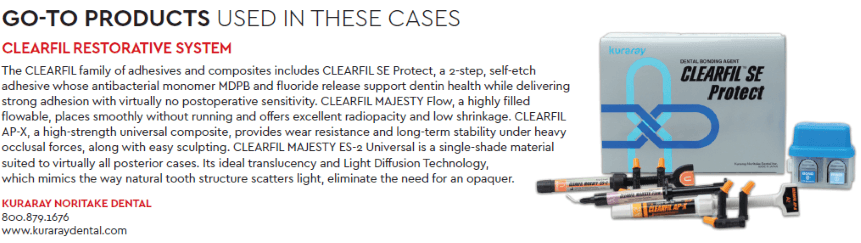
The system presented here uses 4 materials: CLEARFIL SE Protect, CLEARFIL MAJESTY Flow, CLEARFIL AP-X, and CLEARFIL MAJESTY ES-2 Universal. Each has a specific role, and together they cover both direct and indirect posterior workflows—eliminating the need to stock multiple adhesives, flowables, and composites for different procedures.
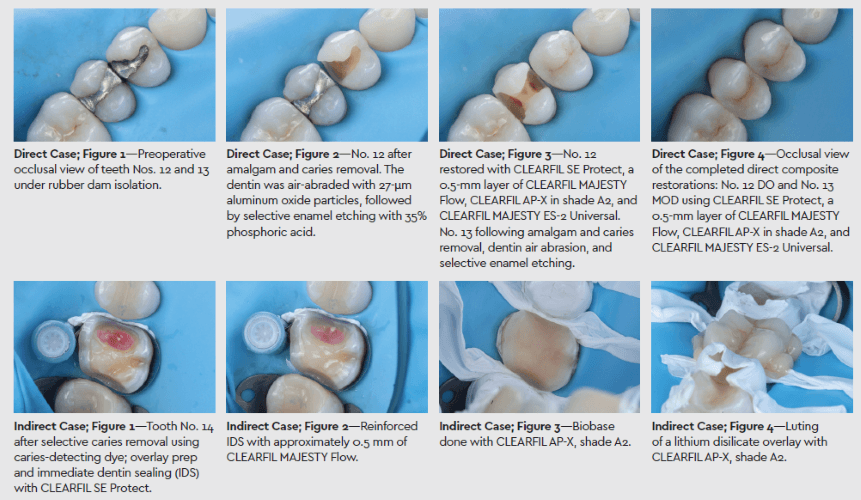
CLEARFIL SE Protect establishes the adhesive foundation, followed by a resin coating of CLEARFIL MAJESTY Flow. CLEARFIL AP-X serves as the dentin replacement composite and, when preheated, can also lute lithium disilicate restorations. CLEARFIL MAJESTY ES-2 Universal completes the restoration as the final esthetic layer.
A Predictable Adhesive Foundation
Restorative success begins at the adhesive interface. However strong or esthetic the material placed above it, long-term success depends on a stable bond to the underlying tooth structure.
CLEARFIL SE Protect is a 2-step, self-etch adhesive containing the functional monomer 10-MDP, the antibacterial monomer MDPB,1 and fluoride. When combined with selective enamel etching, its mildly acidic primer interacts with dentin while preserving hydroxyapatite for chemical bonding with 10-MDP.2
Beyond the hybrid layer, the adhesive’s interaction with dentin also helps form an acid-base resistant zone—a reinforced region beneath the interface that is described in the literature as “Super Dentin.”3
Direct Restorations
Posterior composite restorations should blend naturally with the surrounding dentition without requiring an extensive inventory of dentin, body, enamel, translucent, and effect shades.
CLEARFIL AP-X, a highly filled micro hybrid composite, serves as the dentin replacement; its mechanical properties and handling make it well suited to the posterior. Its opacity adds a clinical advantage: in my experience, approximately 1.5 to 2 mm of material can mask even heavily amalgam-stained dentin, creating a neutral foundation for the final esthetic layer.
CLEARFIL MAJESTY ES-2 Universal then replaces enamel as the final esthetic layer. Its Light Diffusion Technology, optimized translucency, and adjusted chroma help it blend with the surrounding tooth structure. For routine posterior restorations that don’t call for layering, it can also be used on its own.
Indirect Restorations
Immediate dentin sealing (IDS) is the application of adhesive to freshly cut dentin immediately after tooth preparation—before scanning or impression-taking and provisionalization. Because freshly cut dentin is an ideal bonding substrate, IDS is preferable to delayed dentin sealing at the time of final restoration delivery.4,5 Resin coating builds on IDS by adding a thin layer of flowable composite over the polymerized adhesive. Because the adhesive layer is only about 40 £m thick, the flowable composite provides additional reinforcement to the adhesive interface.6
In this system, CLEARFIL SE Protect is used for IDS, followed by approximately 0.5 mm of CLEARFIL MAJESTY Flow, a highly filled, radiopaque, medium-viscosity flowable composite.
CLEARFIL AP-X can also be used for indirect restoration delivery. When preheated, it can achieve a very thin film thickness, reported in the 6- to 8-.m range,7 allowing proper seating of the restoration while retaining the benefits of a restorative composite.
Streamlining with Less
The objective is not simply to use fewer materials but to use fewer materials intelligently. With these 4 carefully selected materials from Kuraray Noritake Dental, each serving a specific role, the same system can be used predictably across both direct and indirect posterior dentistry.
References:
1. Imazato S, Kuramoto A, Takahashi Y, Ebisu S, Peters MC. In vitro antibacterial effects of the dentin primer of CLEARFIL Protect Bond. Dent Mater. 2006;22(6):527–532.
2. Yoshida Y, Nagakane K, Fukuda R, et al. Comparative study on adhesive performance of functional monomers. J Dent Res.2004;83(6):454–458.
3. Nikaido T, Inoue G, Takagaki T, et al. New strategy to create “Super Dentin” using adhesive technology: Reinforcement of adhesive-dentin interface and protection of tooth structures. Jpn Dent Sci Rev. 2011;47(1):31–42.
4. Magne P, Kim TH, Cascione D, Donovan TE. Immediate dentin sealing improves bond strength of indirect restorations. J Prosthet Dent. 2005;94(6):511–519.
5. Magne P, So WS, Cascione D. Immediate dentin sealing supports delayed restoration placement. J Prosthet Dent. 2007;98(3):166–174.
6. de Carvalho MA, Lazari-Carvalho PC, Polonial IF, de Souza JB, Magne P. Significance of immediate dentin sealing and flowable resin coating reinforcement for unfi lled/lightly fi lled adhesive systems. J Esthet Restor Dent. 2021;33(1):88–98.
7. Magne P, Alawie S, Magne M, Carvalho M, Milani T. Comparison of film thickness of restorative composites considered for thermo-modified cementation. J Esthet Restor Dent. 2025;37(1):28–38.
