


Sharper Images in the Palm of Your Hand

Author
By: Dental Product Shopper
10/23/2026

Dr. Brett Silverman on how the next-generation NOMAD Pro 3 provides exceptionally clear images and, when paired with AI-supported findings, gives patients an objective path to the treatment they need


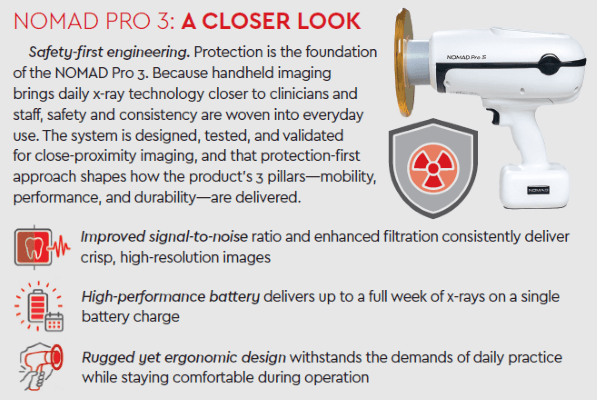
When Dr. Brett Silverman was building his new office in Alpharetta, GA, he had a choice to make about X-rays. Rather than install what he calls "1970s-era" traditional units—bolted to the wall, with team members running in and out of the room to capture an image, adjust, and then repeat—he bought his first NOMAD portable x-ray system.


He wanted to be certain of his choice before putting it to work. "I actually hired a physicist to come out and test the NOMAD to make sure it was safe for everyone in terms of radiation," he recalled. "I remember him bouncing up and down saying how unbelievable and great the units were."


Since then, Dr. Silverman has used several NOMAD units, recently upgrading to the NOMAD Pro 3. With each generation, he said, ease of use and imaging quality have consistently improved.


For his team capturing X-rays day in and day out, the NOMAD Pro 3 has been "pick up and go." The unit’s optimized presets help eliminate guesswork for quicker imaging—users can stay chairside while capturing a full-mouth series in 5 minutes or less."


Over time, the X-ray units bolted to the wall can start to drift and move, and too often we were fighting the drift of those long arms," Dr. Silverman explained. "This eliminates that whole issue—you walk in, point, zap, and you’re done."
 

1792765272923-Screenshot 2026-10-23 101717.png

AI: The Voice of Reason


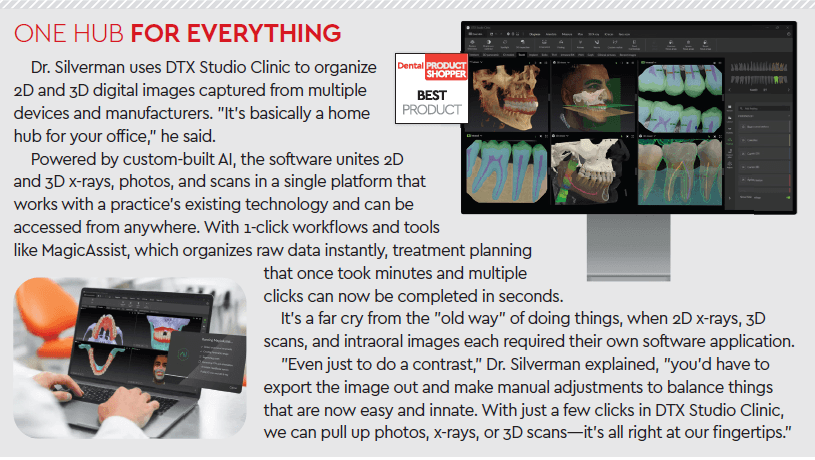
Dr. Silverman admittedly likes to use technology for efficiency, which is why he pairs 2D X-rays captured with his NOMAD Pro 3 and DEXIS Platinum sensor with the DEXassist Solution, which identifies up to 14 AI-supported findings on 2D images, including direct restorative indicators, enhanced caries visualization, and alveolar bone levels. Because the AI findings are integrated into his imaging software, the process is easy.


Dr. Silverman "really, really loves the AI" for 2 reasons. First, it highlights findings he can verify or dismiss, allowing him to create a stronger diagnosis and treatment plan. Second, and equally important if not more so, is patient education.


"I'll pull it up on the screen and talk about the findings,” he said. “I let patients know I'm using AI to help verify some areas of concern on the X-ray, whether it's calculus, bone loss, a root canal issue, or decay."

1792765335339-Screenshot 2026-10-23 101730.png

 Showing, Not Selling


That approach paid off recently, when Dr. Silverman saw the teenage son of a longtime patient for the first time. He noticed a few teeth with black spots—possible decay—though the family's pediatric dentist had already checked them and said they were fine.


"I said, 'Let's look at the photos.' We brought up the X-rays with the AI, and it pointed right to the black areas on those teeth. We then had the deficiency showing up on the X-ray so we could confirm the location visibly, as well as radiographically, and it was independent—not just me saying it. A lot of people will laugh and say, 'Oh, you just want a new car or a boat,'" he continued, “but when I use AI to point out the issues and it's not subjective, it takes that out of the equation."


For example, if he tells a patient the AI is pointing out bone loss, they might say, "Oh yeah, the hygienist has been talking to me about that."


"I can show them exactly where the infection is eating away at their bone. It's purely objective," Dr. Silverman said. "I'm not selling them, I'm educating them.


"That objectivity, he said, changes the entire conversation.


"It's incredible. When you bring in AI to highlight findings for you to confirm or deny, and as an educational tool for a patient, the trust skyrockets because they believe AI. It's just an unbelievable difference. Patients stop questioning whether they truly need something done."


Ultimately, the goal is for patients to take ownership of their care. "I never want anyone to feel manipulated; I want patients to say, 'Oh, I see how I need this treatment and I want to get it taken care of.' At that point, it becomes their drive, not me pushing them."


Going Beyond 'Just Fine'


For colleagues hesitant to invest in new technology, Dr. Silverman has a familiar line: "The old joke is, 'Hey, the '70s called and they want their dentistry back.'


"The traditional dentist mentality is that new technology costs a lot of money," he continued. Why would you spend more if what you’re doing is working? My thought is always, 'Is fine good enough for you and your patients, and is that where you want to live?' I don't want to live in 'just fine.' I want to live with success, ease, and a good flow. Why have daily frustration when it can be easily eliminated?”