

Sterile Single-Patient and Multi-Use: Choosing the Right Bur for the Right Clinical Need

Author
By: Dental Product Shopper
9/8/2026

Dr. John Kois weighs in on what clinicians should consider when selecting burs
 

jundigbrass2600.png

All too often, clinicians decide which burs to invest in based on price, not which instrument is best for the job. Today's practices have 2 options, each suited to a different need: multi-use diamonds for durability and multiple uses, and sterile single-patient diamonds for convenience, infection control, and a streamlined single-patient workflow. Rather than ranking one above the other, the goal is matching the right diamond to the case in front of you.


To make the best bur choices for your practice, Kois Center Director Dr. John Kois encourages clinicians to look at 4 key areas before purchasing: efficiency, consistency, infection control, and economics.


"Economics is the one people default to first, but to me, it's actually the last variable that should drive the decision," Dr. Kois said. "The cost of a remake or a compromised margin can significantly outweigh the price difference between bur options." It's also critical to invest in entire systems rather than individual burs, Dr. Kois added. That way, you have easy access to burs designed to be used for specific purposes and in a specific sequence.


Remember: Quality Matters


A bur's diamond quality has a huge impact on prep precision, efficiency, and, ultimately, treatment outcomes, Dr. Kois said, yet it's an underappreciated factor. Why? The effect is often invisible until you compare it directly. Enamel is variable, Dr. Kois explained. Some patients have enamel that feels like butter when you cut into it, and others feel more like granite—a difference you can't measure but can certainly feel when you're preparing a tooth. A sharp, well-graded diamond will predictably remove tooth structure in both cases. However, a diamond past its prime will require more pressure. Diamond quality and sharpness, Dr. Kois said, "is a meaningful driver of same-day efficiency and long-term restoration success."


"Most clinicians think about the bur at the moment of purchase and then forget about it entirely until it fails mid-prep," Dr. Kois said. "What gets overlooked is diamond burs have a performance curve; they cut differently on stroke 50 than they do on stroke 5."


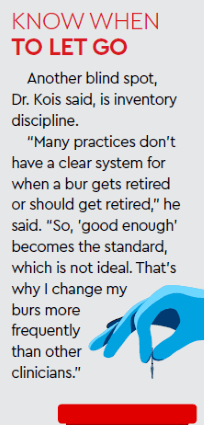
It's also important to remember that degraded diamonds are more difficult to clean, Dr. Kois shared. "A diamond that has passed its useful cutting life is an efficiency, consistency, and infection control liability." It's worth noting that sterile single-use diamonds sidestep this performance curve entirely—each one delivers a fresh cutting surface and is discarded after a single patient.


jundigbrass2601.png

Single-Use and Multi-use Burs: Understanding the Difference


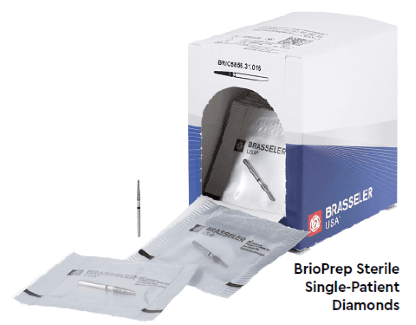
There's a place for both sterile single-patient and multi-use diamonds in today's practices, Dr. Kois said. BrioPrep sterile, single-patient diamonds are designed for use on one patient and disposed of after the procedure, providing a fresh bur for every case while eliminating the cleaning, sterilization, and bur tracking that repeated use requires.


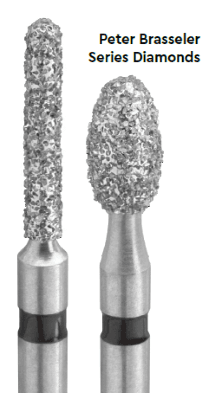
That makes them well-suited to high-volume workdays and lower-complexity preparations where a ready-to-go, single-patient workflow keeps the schedule moving. Peter Brasseler Series multi-use diamonds, built for durability and repeated use, earn their place in more complex and esthetic cases where prep precision is critical and margin quality directly determines the restoration’s longevity.


Regardless of the option you choose, it's important to know which diamond shapes and grits to use in each scenario. For example, Dr. Kois uses fine-grit finishing diamonds for margin refinement and said you should never use a medium or coarse grit diamond to adjust porcelain restorations because it creates stress, potentially introducing microcracks that can cause issues later.


"The practices that are operating most efficiently are the ones that match the bur system to the procedure rather than standardizing one option for everything," Dr. Kois said.
 

jundigbrass2602.png

Brasseler's Reputation for Excellence


The biggest differentiators for Peter Brasseler multi-use and BrioPrep sterile single-patient diamond burs? For Dr. Kois, it's diamond grit consistency, bond quality between diamond particles and shank, and manufacturing tolerances that hold up over repeated sterilization cycles.


"I have found Brasseler's reputation in the instrument space is built on manufacturing consistency at scale."


It comes down to this: With Peter Brasseler multi-use diamond burs, clinicians know they have a dependable instrument that will give them predictable results. "The clinicians I work with and teach at the Kois Center have learned to trust that the grit and shape will perform the same way today as it did a year ago," Dr. Kois said, "which matters enormously when you're trying to perfect a technique so you can deliver repeatable results."


Whether the case calls for a Peter Brasseler multi-use or a BrioPrep sterile single-patient diamond, choosing the instrument built for that job offers predictability and helps ensure you're working with a sharp, high-quality diamond every time. "Chair time, your remake rate, and the clinical outcome are all impacted by the bur you use," Dr. Kois explained, "and they all have a dollar value—even though they don't appear on the instrument purchase invoice."