


Praised for its versatility and calcium-releasing benefits, Bisco’s Thera family of restoratives once again tops the list of DPS reader’s most trusted materials
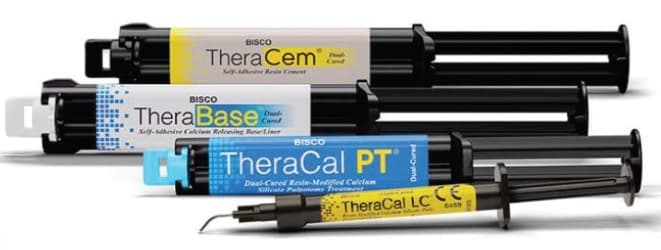
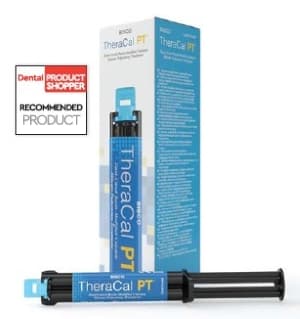
“When I have situations where the caries is very deep or causes a pulpal exposure, I rely on TheraCal LC to protect the pulp,” shared Craig Aebli, DDS, MS, FAGD, who began using TheraCal LC in his Sanford, FL, practice shortly after it was introduced. “I would say for the majority of the time, patients have come back not complaining about any symptoms with the tooth. So, it seems that it is working to provide that pulpal protection. It is also easy to place and sets up easily with light curing,” he added.
TheraCal LC is a calcium-releasing1 used as a protective liner under composites, amalgams, cements, and other base materials. Bacterial growth can be deterred2,3by using calcium-releasing materials such as TheraCal LC because they create an alkaline pH. TheraCal LC also protects the dental pulp4,5 and stimulates hydroxyapatite formation.6,7
“I was skeptical when I first learned about TheraCal LC’s calcium-releasing benefits, but I have seen a 50% to 60% reduction on teeth that were predestined to need endo treatment. TheraCal LC is a flagship product for deep caries removal," added Dr. Glasmeier, who noted that it was a free sample of TheraCal PT that first got him “hooked” on the Thera family.
Easy to Use Without Sensitivity
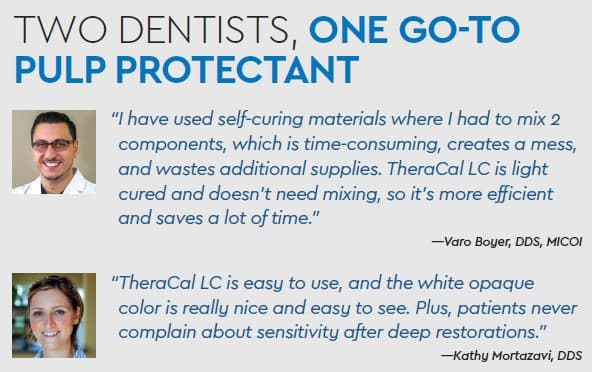
Dr. Boyer also finds TheraCal LC to be particularly helpful for patient sensitivity and points to its ease of use as another reason it’s been a mainstay in his armamentarium for several years. “It helps a lot to minimize patient sensitivity in deep decay situations,” he shared, “and it is easy to dispense and use. In my experience, it has a perfect consistency: it’s runny enough to cover the intended area, yet sticky enough not to go all over the preparation, which then requires more cleanup. I’ve found it to be very efficient to use and not time consuming at all.”
Kathy Mortazavi, DDS, has been using TheraCal LC for 7 years. “I strongly believe that calcium release eliminates sensitivity after procedures,” she said.
Reduced sensitivity is a benefit noticed by Dr. Glasmeier as well, who shared, "I always see a pretty significant improvement in thermal sensitivity."
And while Bonnie Lau, DDS, in Honolulu, HI, has reached for TheraCal LC for about 10 years, especially when excavation ends close to the pulp, it’s the absence of patient sensitivity that seals the deal.
"TheraCal LC seems to reduce cold sensitivity when close to the pulp," said Dr. Lau, who has also used TheraBase. "My patients seem to tolerate their procedures."
THERABASE
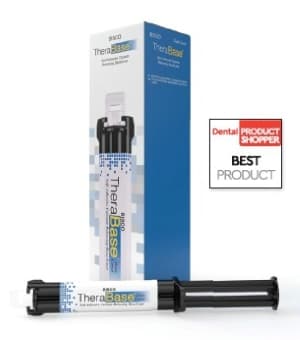
The newest member of the Thera family, TheraBase was launched in 2021 and is a dual-cure, calcium- and fluoride releasing, self-adhesive base/liner that chemically bonds to tooth structure.
With a high compressive strength, the restorative is designed to be stronger and more durable than other base materials and absorbs shock and stress from occlusal forces without fracturing. "After mixing, TheraBase stayed exactly where I placed it, allowing me to finish the restoration efficiently,” Dr. Theodore
Holubec shared. "I felt confident using it in deep restorations due to its dual-cure properties."
TheraBase contains the MDP monomer for a reliable bond to dentin and features an automix dual syringe that allows for immediate delivery and a consistent mix.
THERACEM
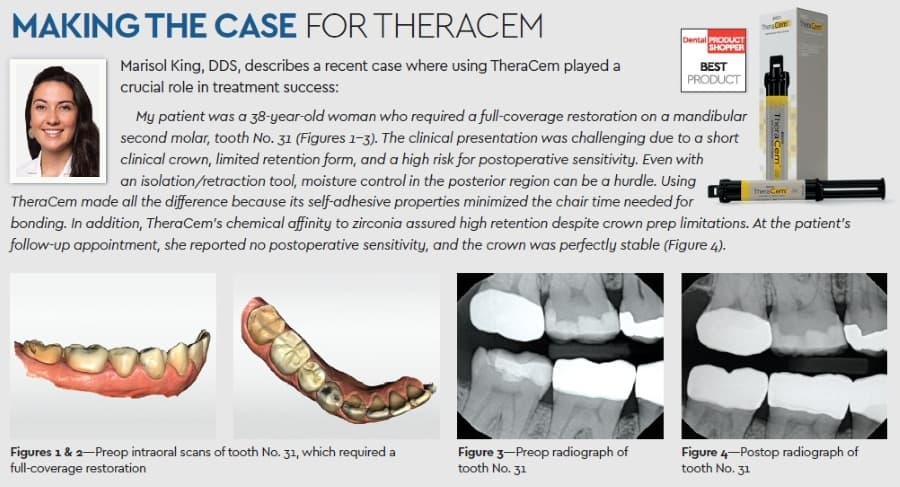
“There is a tremendous number of cement choices in the dental market, and honestly, I feel clinicians are over-saturated with options,” shared Marisol King, DDS, in Rio Rancho, NM.
Enter TheraCem, a dual-cure, self-adhesive resin cement BISCO introduced in 2017. With a continuous calcium and fluoride release, TheraCem takes just minutes to transition from acidic to alkaline pH.* It is indicated for luting crowns, bridges, inlays, and onlays, as well as prefabricated metal, nonmetal, or fiber posts.
It’s a go-to for Dr. King, who was looking for a reliable, streamlined cement that would offer a strong, predictable bond without requiring a multistep process. But it was the continuous release of calcium and fluoride that she found to be a unique biological advantage compared to conventional resin cements.
“TheraCem sets itself apart through its ease of use and physical properties,” she shared. “It eliminates the need for etching or priming, which noticeably speeds up my chairside workflow and reduces technique sensitivity. The cleanup is effortless and its chemical makeup helps reduce postop sensitivity, resulting in much higher patient comfort. It’s my go-to for cementing indirect restorations, particularly zirconia and metal-based crowns.”
While offering clinicians an easy cleanup, TheraCem also provides superior durability and strength as well as a high radiopacity.
“I love that it is so easy to use and so easy to clean,” Dr. Mortazavi shared. “Patients do not report sensitivity after crown cementation.”
Dr. Emery Cole began using TheraCem almost a decade ago, finding it a “versatile” product and a good choice because of its dual-cure formulation.
“I use it for almost all my ceramic cementations and endodontic posts and occasionally for crown margin/root caries repair,” Dr. Cole said. “Sometimes, I reach for it as a cavity liner in deep caries restorations. I’ve found success when using it as a shade blockout as it is a very opaque, flat-white shade, allowing me to bond composite over it cosmetically. And I don’t have to stock specialty opaque composite shades anymore.”
A Trusted Company
“BISCO’s line of products has been around for a while with a supportive den-tist population and long-term results,” Dr. Glasmeier added. “These materials allow dentists like me to be conservative while delivering results in situations that previously would have been doomed to more aggressive treatment.”
“I trust these materials—they give me dependable, economical results, and I’ll continue to use them in my practice,” Dr. Lau concluded.
References
*Data on file.
**Satisfaction survey results of 349 responses from U.S. clinicians.
1. Gandolfi MG, Siboni F, Prati C. Chemical-physical properties of TheraCal, a novel light-curable MTA-like material for pulp capping. Int Endod J. 2012;45(6):571–9.
2. ElReash AA, Hamama H, Eldars W, et al. Antimicrobial activity and pH measurement of calcium silicate cements versus new bioactive resin composite restorative material. BMC Oral Health. 2019;19:235. doi.org/10.1186/s12903–019-0933-z.
3. Kim RJY, et al. An in vitro evaluation of the antibacterial properties of 3 Mineral Trioxide Aggregate (MTA) against five oral bacteria. Arch Oral Biol. 2015;60(10):1497–1502.
4. Sangwan P, Sangwan A, Duhan J, Rohilla A. Tertiary dentinogenesis with calcium hydroxide: A review of proposed mechanisms. Int Endod J. 2013; 46(1):3–19.
5. Savas S, Botsali MS, Kucukyilmaz E, Sari T. Evaluation of temperature changes in the pulp chamber during polymerization of light-cured pulp-capping materials by using a VALO LED light curing unit at different curing distances. Dent Mater J. 2014;33(6):764–9.
6. ADA definitions for direct and indirect pulp capping at https://www.ada.org/publications/cdt/glossary-dental-terms.
7. Gandolfi MG, Siboni F, Taddei P, Modena E, Prati C. Apatite-forming ability of TheraCal pulp-capping material. J Dent Res. 2011; 90(Spec Iss A):abstract number 2520. www.dentalresearch.org.
8. Okabe T, Sakamoto M, Takeuchi H, Matsushima K. Effects of pH on mineralization ability of human dental pulp cells. J Endod. 2006;32(3):198–201.