


Home  /  
Articles  /  

Why I Use… MTA vpt

Author
By: Dental Product Shopper
7/30/2026

Esthetic, biocompatible MTA cement promotes remineralization and offers reliable pulp protection

 

mvaptvoco00.jpg

PETER AUSTER, DMD, FICD, FACD

Dr. Auster is a partner at Cosmetic Dentistry Associates in Pomona, NY. He completed 12 years in leadership positions at the American Academy of Cosmetic Dentistry and served as the Professional Education and Leadership chair. He is a fellow of the American College of Dentists and the International College of Dentists. Dr. Auster is founder and past president of the Greater New York Academy of Cosmetic Dentistry and is a Dawson Academy Scholar. He has authored many articles in dental journals and lectures internationally. He is proud to be a speaker for Catapult Education and is thrilled to prepare for his 13th year providing humanitarian dentistry in Jamaica.


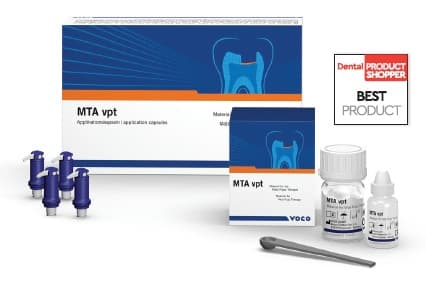
Over a 30-year career as a cosmetic dentist and sought-after dental educator, Peter Auster, DMD, FICD, FACD, has tried dozens of pulp-capping materials and found drawbacks with most. VOCO's MTA vpt, which offers more than double the compressive strength of other MTAs, was different. Here, Dr. Auster explains why it's earned a permanent spot in his pulp-capping armamentarium.

 

mvaptvoco01.jpg

I started using MTA vpt for direct and indirect pulp capping just a few months ago, and I saw very quickly that it's an ideal restorative material. Why? It delivers the benefits of other MTA materials without the drawbacks I've run into with them.


MTA vpt stays permanently white because it's free of iron-containing compounds and bismuth oxide, unlike some MTA products that can discolor a restoration. It's also easy to dispense, readily injectable into a deep decay area, and it doesn't lift off wet dentin the way other products do.


Immediate Placement


MTA vpt is condensable, strong, and fast-setting, and I love that I can deliver a final restoration immediately after placing it.


The seal works beautifully. Its high compressive strength is a major plus, and so is the fact that it's bacteriostatic: MTA vpt releases calcium and hydroxide ions that encourage reparative dentin growth and pulp regeneration, and the resulting high pH both fights bacteria and promotes remineralization.


Those qualities point to strong long-term effectiveness—potentially eliminating the need for root canal treatment or retreatment.


I've yet to have a patient complain of postop sensitivity in my pulp-capping cases. And while it's too early to judge long-term outcomes, my initial results have been entirely positive.


Case in Point


A 35-year-old woman had extremely deep decay on tooth No. 30, beneath an old restoration. Removing the previous restoration revealed disto-occlusal decay. A caries indicator paste showed that most of the decay was removed, but I felt further excavation could result in a pulp exposure.


After using an antibacterial scrub, I placed a thin layer of MTA vpt directly over the deepest spot, and then restored the tooth using etchant, VOCO's FuturaBond U adhesive, and GrandioSO 4U composite. Two months later, my patient remains symptom-free.


Answers Every Issue


I'm excited about MTA vpt and highly recommend it to my colleagues. Other MTA materials I've tried are expensive, require a 10-minute wait before placing a restorative, or are difficult to apply—and then there's the color problem, where the material shows through the restoration. MTA vpt has answered all of those issues.