

ZirClean and TheraCem: Even Better Together

Author
By: Dental Product Shopper
7/29/2026

A prominent implant and general dentist explains how ZirClean and TheraCem work together to ensure bonds stay strong and that cementation procedures are more efficient
 

biscodig2600.jpg

When Honolulu-based implant and general dentist Dr. Michael L. Nishime first tried ZirClean and TheraCem, he was looking for a simpler, quicker method to cement zirconia crowns. He certainly found it with this powerful pair of BISCO products.


ZirClean and TheraCem work together to deliver “clean” cementation, and as Dr. Nishime put it, are “ideally suited to be used with zirconia.”


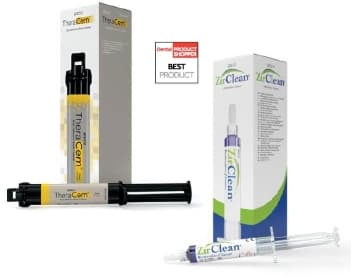
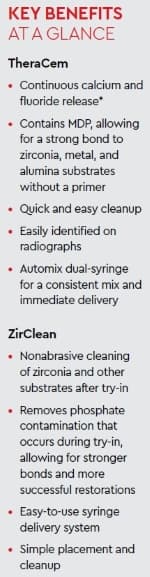
So, what makes this the perfect combo for zirconia? After try-in, ZirClean nonabrasively cleans the restoration’s bonding surface, removing saliva and phosphate contaminants that can hinder the bond. Then, TheraCem, with its dual-cure, self-adhesive properties and long-term adhesion, cements the restoration. And because it contains the MDP monomer, TheraCem creates strong bonds to zirconia and other substrates without the need for a primer—saving time.


biscodig2601.jpg

At Advanced Restorative Dentistry, Dr. Nishime places primarily zirconia crowns and knows he can trust the easy-to-use ZirClean to rid the surface of bond-inhibiting contaminants. And with TheraCem, his go-to for zirconia crowns and bridges, the bonding procedure has fewer steps, making it more efficient.


“The elimination of the bonding step sets TheraCem apart from the previous resin cements I've used," he said.


And cleanup? With TheraCem, it’s a breeze.


“I find that cleaning up TheraCem is much easier than the resin cement I was using,” he said, “therefore reducing the time involved to cement a crown.” 


Cost-Effective and Time-Efficient


Dr. Nishime delivers at least 1 implant crown in his practice just about every day, with his single-crown cases primarily screw-retained. He finds the TheraCem and ZirClean combination works especially well when cementing a zirconia crown to an abutment. Once he places the calcium- and fluoride-releasing TheraCem, he’s done—no bonding step required.


“Once the crown is back from the lab, I can cement it to the abutment using TheraCem and screw in the abutment/crown to the implant in the patient’s mouth,” he explained. “This whole process is very cost-effective and time-efficient.”


The workflow is also less stressful now, for both Dr. Nishime and his patients. In the past, he had to worry about the bonding agent fusing interproximal contacts

together—a problem that took a ribbon saw to fix and added time to both the procedure and the cleanup. Now, he doesn’t have to use a bonding agent, eliminatingthat risk.



biscodig2602.jpg

“With TheraCem, this doesn't happen,” he said. “This saves a few minutes during a cementation procedure, which may not add up to a lot of time in the course of a

day or week, but the amount of stress it reduces for me and the patient is invaluable.”


Reliable Bonds


TheraCem is easy to use and clean up, and when combined with ZirClean, it helps clinicians like Dr. Nishime ensure patients receive strong, reliable bonds that stand the test of time. He described both products as excellent and would gladly recommend them to colleagues.


When paired together, ZirClean and TheraCem provide a clean restoration surface and reliable, long-term adhesion. They simply “make cementation more efficient and less stressful,” he said, and that’s a win for any dental practice.

Shop Now