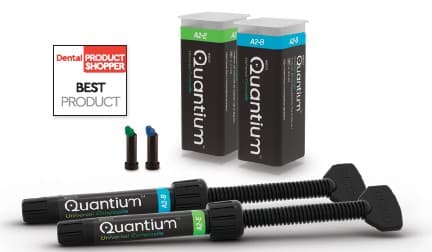
Having performed direct resin restorations for nearly 4 decades, Dr. Howard Glazer had a natural reaction when he heard about yet another universal composite coming to market: “Do we really need another composite?” he wondered. The answer, he soon discovered, was an emphatic “yes.”
“We did need this one, because it turned out to be a game changer,” said Dr. Glazer, an educator and past president of the Academy of General Dentistry.
One of the first things that stood out was the material’s versatility when it comes to handling. “There’s always a lot of talk about warming composites to make them more fluid and get better marginal adaptation so there’s less leakage,” he explained. “This composite was actually formulated to be heated (in unit dose), and here’s the deal—it works the same whether you heat it or not. That flexibility lets clinicians choose their delivery without sacrificing performance. It’s absolutely terrific.”
Strength, Radiopacity, and the ‘Wow’ Factor
For Dr. Glazer, any restorative material must check a few essential boxes: high strength, low shrinkage, radiopacity, and esthetics. This new composite, he said, delivers on all counts.
“If you have too much shrinkage, you end up with microleakage, and that becomes a problem,” he said. “This material shows low shrinkage. It’s highly radiopaque, which is important for following cases over time. And the esthetics, which is what’s important to the patient, can get you that ‘wow’ factor. When you hand them the mirror, if they say, ‘Oh wow,’ then you’ve got the right material.”
Quantium is offered in 6 VITA shades, each available in an opaque body and a more translucent enamel, along with bleach and incisal effect shades. “It’s a nice range of shades, and you have options to finesse the restoration depending on how much you choose to do,” Dr. Glazer explained.
A Workhorse for Everyday Dentistry
Dr. Glazer described the composite as a true “workhorse,” suitable for anterior and posterior restorations. While many materials are technically indicated for both, he noted that clinicians often avoid using them in the esthetically demanding anterior region. “This one doesn’t have that asterisk where you choose to use it mostly in the posterior,” he explained. “I am comfortable using this in any restoration and any classification. And it works.”
Backed by Science
Equally important, Dr. Glazer emphasized, is the science behind the material. He regards BISCO among a select group of manufacturers whose research and testing can be trusted. “They’ve made their mark with this one,” he said. “It has the esthetics, the handling, the radiopacity, and the testing shows it has the volumetric strength, the flexural strength, and the compressive strength. Kudos to BISCO—they really came up with a winning product.”