No Firing, No Delays
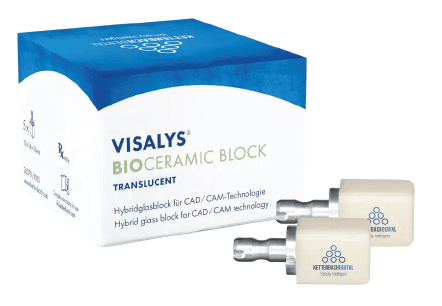
A biomimetic material combining strength, esthetics, and flexibility, the Visalys BioCeramic Block suits a range of restorative applications. Since its release earlier this year, Sam Halabo, DMD, of San Diego, CA, has used it to mill crowns from premolars to anteriors, though he reaches for it most when placing inlays and onlays.
“These preps are conservative, and you don’t have to remove as much healthy tooth structure as you would with a crown,” he explained. “So, this material fi ts in very well with that application.”
Christopher Baer, DMD, of Lone Tree, CO, who has also worked with the block since launch, prefers it for posterior crowns and onlays, appreciating how little time and effort it takes to achieve optimal results.
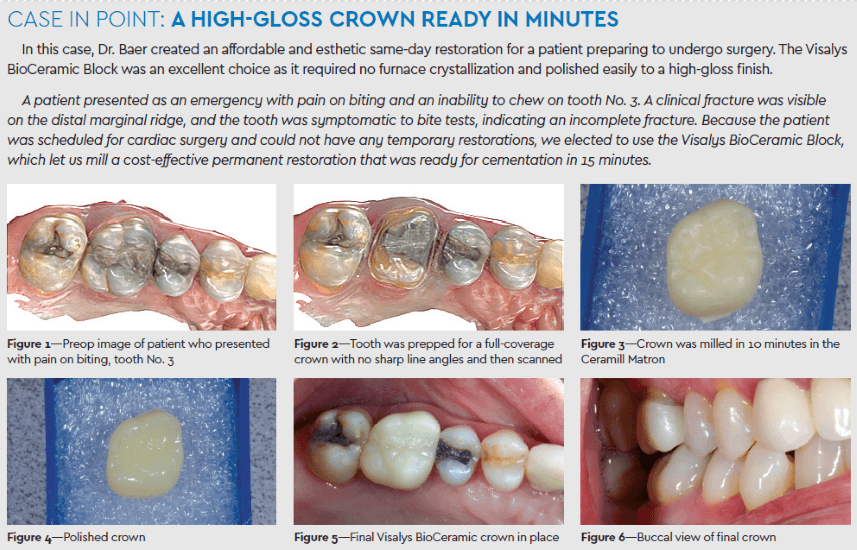
“You’re able to mill, and in less than 5 minutes, you’ve finished polishing it,” he explained. “It makes same-day restorations a breeze.”
The hybrid glass block skips the oven thanks to a special manufacturing process. By contrast, Dr. Baer noted, a lithium disilicate restoration typically needs a 15-minute crystallization cycle, another 15 minutes for stain and glaze, and a cooldown period before it can go in the mouth—with a team member tied up the whole time.
“Everybody’s okay with 15 minutes,” Dr. Baer said. “But when you tell a patient they have to wait an extra hour, they start asking, ‘Can I just come back?’”
When a patient is missing a crown, Dr. Baer can design and deliver a replacement within a normal visit. He’s also found the block is a good answer for an existing amalgam restoration with a fractured buccal cusp—an onlay takes about as long as a buildup and a filling, but the patient goes home with a “much more durable restoration.”
Built to Last, Easy on Burs
Kettenbach designed the block with strength comparable to lithium disilicate and dentin-like elasticity, so a restoration holds up under occlusal forces while behaving like a natural tooth.
“We don’t have long-term studies on it,” said Dr. Halabo, noting the product has only been available a few months. “But so far, these types of materials typically wear very well in the mouth.”
The block also offers the esthetic qualities of glass-ceramics—natural translucency, opalescence, and flexible color matching. While Kettenbach makes a more translucent block for higher-esthetic anterior cases, Dr. Baer has worked exclusively with the high-chroma version.
“As far as blending in and being true to shade, I think it does a really nice job,” he said. “If you’re looking for an A2, it will blend in with an A2 perfectly.”
The block carries the flexibility and workability of a composite, making it a cost-effective choice. “These materials are much softer and easier to cut through,” Dr. Halabo said, “so the milling burs tend to last a lot longer, which saves you money.”
Easier to cut hasn’t meant easier to break. Harder blocks, Dr. Baer noted, tend to chip in thin areas once tools wear past roughly half their working life, turning a finished restoration into a “no-go” that has to be re-milled.
“We haven’t had any issues with this block chipping on the margins,” he said.
Rounding Out the Workflow
Dr. Halabo often builds up his preps with Visalys Core, formulated to mimic dentin, and bonds his inlays, onlays, and crowns with Visalys CemCore, a dual-curing adhesive cement—2 materials he said work hand in hand beneath milled restorations.
Dr. Baer keeps Visalys Temp stocked for temporaries and reaches for Visalys Flow—a flowable nanohybrid composite— when a preparation needs help.
“As much as you’d like to have a perfect prep, once you’ve removed decay, you typically don’t,” he said. “Basing out with Visalys Flow is usually ideal.”
A Material Worth Milling
“We found that milling the block on the hybrid setting has worked really well for us,” Dr. Baer explained. “It seems to mill very predictably, and we haven’t had any failures.”
For Dr. Halabo, “Having a material that comes out of the mill looking well-polished that can be placed quickly saves us even more time. It allows us to do what we’ve been doing in a more efficient and esthetic way.”