


BISCO research scientist Natalie Keehan on what goes into a well-balanced universal composite like Quantium—and what it delivers for dentists


Pebbles vs Boulders
Much of the balancing act behind composite formulation comes down to fillers—the hard particles suspended in a composite's resin. "You can build a wall out of boulders, or you can build it out of pebbles," Keehan said.
The pebbles in this case are nanofillers: smaller particles whose greater surface area requires more resin to coat and bind them. Since resin is the weaker part of a composite, which shrinks as it cures, more resin means more volumetric shrinkage and less strength. The upside is that nano-filled composites wear down evenly, resulting in a smooth, polishable surface.
Larger, micron-sized filler particles need less resin, so they shrink less and hold up better under bite force. "The boulders are going to give you a stronger wall," Keehan said. The trade-off is that they wear unevenly: as a restoration ages, whole particles can pop loose at once, leaving a rough, pitted surface behind.
The Best of Both Worlds
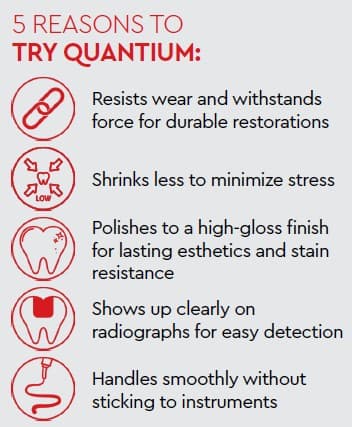
For years, clinicians had to choose between one type of "wall" or another—a strong, low-shrinkage composite for posterior teeth, or a weaker, polishable one for the anterior. Today, agglomerated fillers, the technology behind modern universal composites like Quantium, offer dentists the best of both worlds.
Agglomerated fillers are built by binding nanofillers into micron-sized clusters—like boulders made from pebbles. With less resin content, a composite like Quantium has more strength to withstand occlusal forces. But because the individual filler particles are only loosely bound, they also respond to polishing and natural wear like a nano-filled material.
"The goal is to make the biggest fillers you can to give the restoration strength," Keehan explained. "But when it wears down, you want it to break like pebbles." That leaves you with a smoother surface, which, as Keehan described it, "will help with staining and biofilm for a more esthetic appearance."