


Dr. Chae graduated from the UCSF School of Dentistry in 2000 and is the owner of Diamond Bar Dental Group in Diamond Bar, CA. He also serves as an adjunct clinical instructor at the Herman Ostrow School of Dentistry of USC. Dr. Chae has published clinical cases in Dentistry Today, Dental Products Report, Dental Product Shopper, and Compendium. He can be found on Facebook and Instagram at @jameschaedds, where he shares his clinical work and answers questions from colleagues.
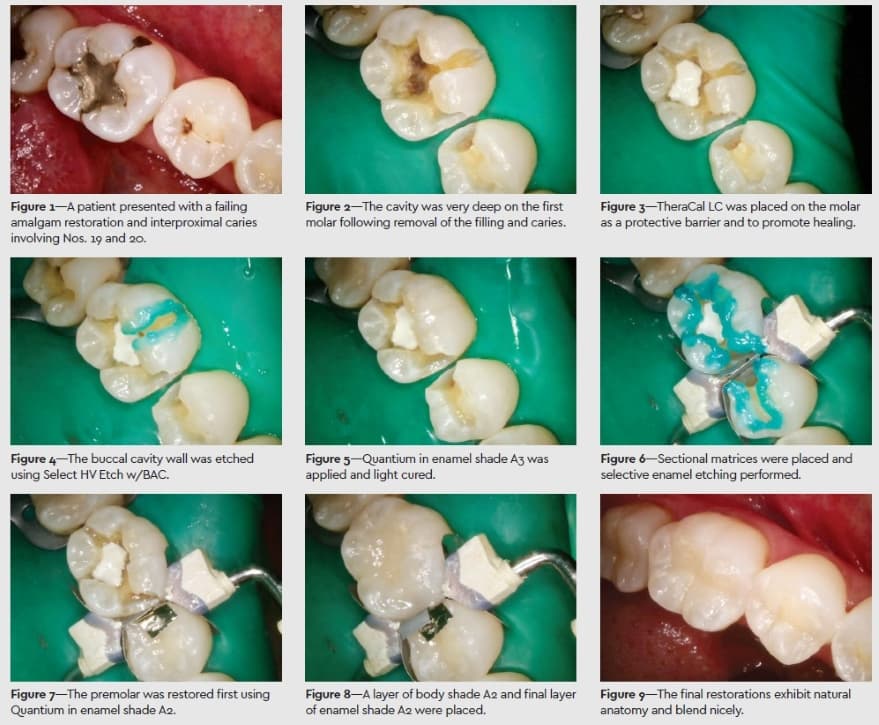
A 40-year-old woman presented with a failing amalgam restoration and interproximal caries in the lower left quadrant involving teeth Nos. 19 and 20 (Fig. 1). Following administration of an inferior alveolar nerve block using 2% lidocaine with 1:100,000 epinephrine, a No. 24 clamp was placed on the second molar, and rubber dam isolation was achieved.
The defective amalgam filling was removed from the first molar, and the initial cavity preparation of the interproximal walls was performed using an inverted cone diamond bur (Brasseler). The soft caries was removed using carbide round burs with a slow-speed handpiece. The resulting cavity on the first molar was notably deep (Fig. 2).
Protecting the Pulp
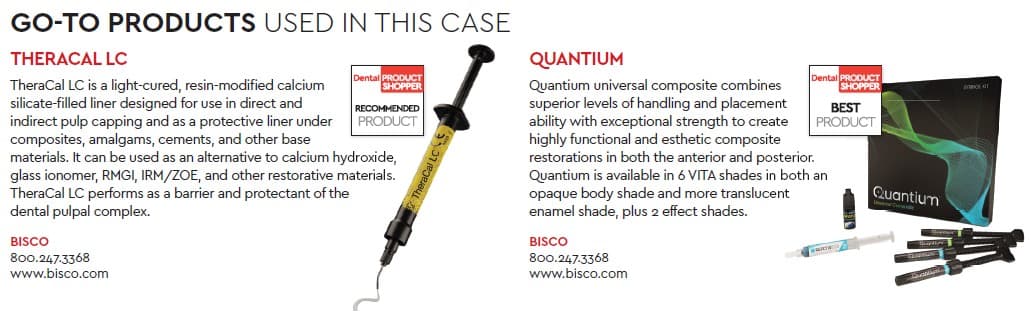
After achieving a clean and neat cavity preparation, the teeth were dried and TheraCal LC—a light-cured, resin-modified calcium silicate from BISCO—was placed (Fig. 3). TheraCal LC can be used as both a direct and indirect pulp capping material, providing pulpal protection and insulation.1,2 Its calcium release3,4 stimulates hydroxyapatite and secondary bridge formation5,6 while also helping mask dark amalgam stains and very dark dentin. The material places easily for efficient, controlled application.
The buccal cavity wall was etched using Select HV Etch w/BAC 35% phosphoric acid etchant (Fig. 4). After rinsing and drying, All-Bond Universal was applied, air-dried, and light-cured for 10 seconds. Quantium universal composite in enamel shade A3 was placed and light-cured (Fig. 5).
Quantium offers a good working time, does not stick to the instruments, adapts well to tooth anatomy with hand instruments, and polishes easily. It also blends naturally with the surrounding tooth structure once it’s finished.
To restore both the molar and premolar, sectional matrices (Composi-Tight 3D Fusion, Garrison Dental) were placed, and selective enamel etching was done using 35% phosphoric acid (Fig. 6). The teeth were then rinsed and dried, followed by an application of All-Bond Universal, which was light air-dried and cured for 10 seconds.
The premolar was restored first using Quantium in enamel shade A2 (Fig. 7). For the molar, a layer of Quantium body shade A2 was placed on the occlusal dentin surface and light cured, followed by placement and curing of the final layer of Quantium in enamel shade A2 (Fig. 8).
A Natural Finish
Lastly, occlusal adjustments and refinement of anatomical details were completed using a flame-shaped diamond bur (Brasseler.) Finishing and polishing were done using a fine-needle diamond bur (Brasseler), a large coarse disc (3M Sof-Lex, Solventum), a #12 blade, and a White Arkansas Stone (Dedeco).
The final composite restorations exhibit natural anatomy and blend nicely with the surrounding tooth structure (Fig. 9).
References:
1. Sangwan P, Sangwan A, Duhan J, Rohilla A. Tertiary dentinogenesis with calcium hydroxide: A review of proposed mechanisms. Int Endod J. 2013; 46(1):3–19
2. Savas S, Botsali MS, Kucukyilmaz E, Sari T. Evaluation of temperature changes in the pulp chamber during polymerization of light-cured pulp-capping materials by using a VALO LED light curing unit at different curing distances. Dent Mater J. 2014;33(6):764–9.
3. Data on file
4. Gandolfi MG, Siboni F, Prati C. Chemical-physical properties of TheraCal, a novel light-curable MTA-like material for pulp capping. Int Endod J. 2012;45(6):571–9.
5. ADA definitions for direct and indirect pulp capping at: www.ada.org/en/publications/cdt/glossary-of-dental-clinical-and-administrative-ter
6. Gandolfi MG, Siboni F, Taddei P, Modena E. Apatite-forming ability of TheraCal pulp-capping material. J Dent Res 90 (Spec Iss A):abstract number 2520, 2011. www.dentalresearch.org