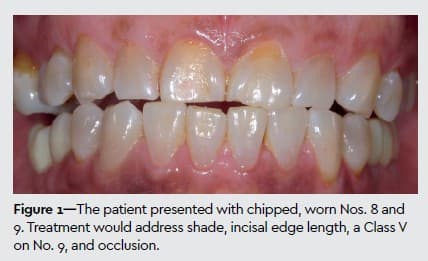
As a dentist, when you hand the patient a mirror and they say, “Oh, wow!” that’s confirmation that you’ve got the right material. This was certainly the case when we restored two maxillary central incisors using Quantium, a light-cured, radiopaque universal dental composite from BISCO. The patient, a woman in her 40s, had fractured and wore down teeth Nos. 8 and 9 mesially and incisally, so much so that only the distal incisal edge of No. 9 could be referenced for the original height. The teeth had been chipped and worn to an inverted “V” shape (Figure 1).
Minimally Invasive Restoration
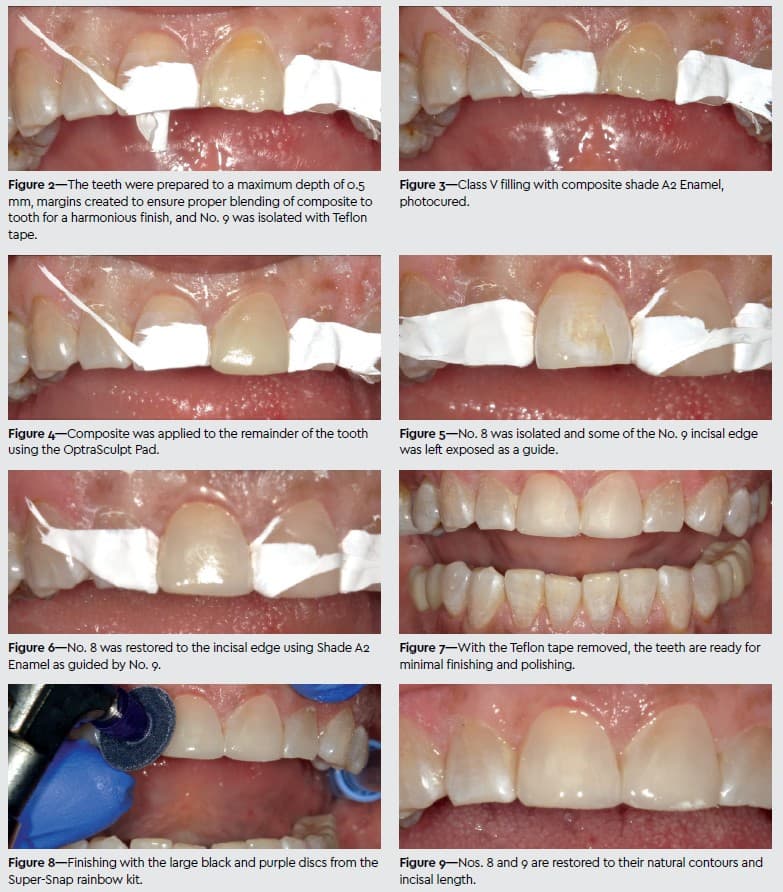
After determining that the A2 Enamel shade would be a match, we prepared both teeth to no more than 0.5 mm at the deepest point, maintaining much of her original enamel. Margins were created to ensure proper blending of composite to tooth for a harmonious finish. We isolated No. 9 using Teflon tape (Figure2). We then etched with Select HV Etch w/BAC (BISCO), rinsed and air dried, applied All-Bond Universal (BISCO), air dried and thinned, and photocured.
We then filled with Quantium A2 Enamel (Figure 3), applying it to the center and using the OptraSculpt Pad (Ivoclar) to compress and move the composite around without any pullback or leaving any indentations. We then applied composite to the remainder of the tooth and gently lipped over the incisal edge, whose length was determined pre-op using the distal-incisal portion of the tooth that was unaffected by wear (Figure 4).
Satisfied with the restoration of No. 9, we then isolated No. 8, leaving some of the incisal edge of No. 9 exposed as a guide for the incisal length of No. 8 (Figure 5). We then completed the same steps used for No. 9—etching, drying and rinsing, applying All-Bond Universal, and photocuring. We applied shade A2 Enamel and restored to the incisal edge (Figure 6). As with No. 9, the surface of the composite was 95% finished and polished just by applying Quantium with the OptraSculpt Pad (Figure 7).
We finished with SS White burs and polished using the Super-Snap rainbow kit (Shofu), moving from the large black disc to purple for smoothing (Figure 8). With the patient sitting upright, we checked the occlusion and made final adjustments with a football-shaped fine diamond (SS White). We applied DirectDia Paste (Shofu) to the tooth surface and used a red disc for polishing, followed by the green for high gloss.
We made sure the patient was comfortable in occlusion both laying down and upright, ensuring there is freedom of movement without chipping the incisal. We then handed the mirror to the patient and got a very enthusiastic “Oh, wow!” response to the completed treatment (Figure 9).
A Durable and Esthetic Alternative
All too often, even for cases like this, dental students and professionals are taught to pursue a lab-processed veneer, or worse, cut the tooth down for a crown, which was not necessary here. These minimally invasive direct composite restorations will last the patient many years with proper care, thanks both to the technique and the durability of the composite—representing a more economical means of achieving a highly esthetic result.
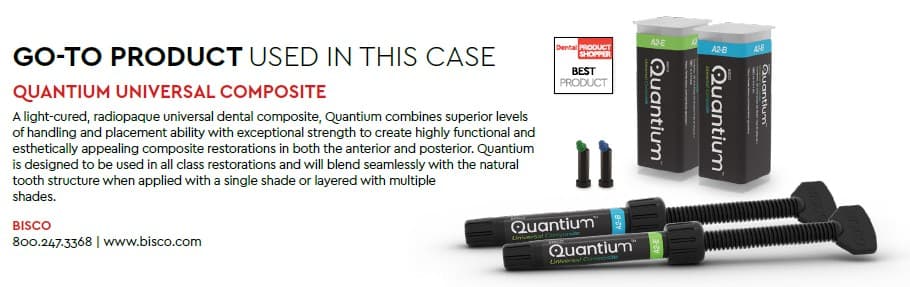
Quantium has the esthetics, handling, radiopacity, as well as the volumetric, flexural, and compressive strength needed to be a winning product.