



Dr. Yasuda Rainey puts patient-centered care at the core of her clinical practice. She aims to provide high-quality care using exceptional dental materials, while providing the most comfortable experience possible. In addition to caring for patients, she lectures across the U.S. and abroad on comprehensive restorative techniques to dentists and their teams. She is on the Speakers Bureau at Catapult Education, is a key opinion leader for several dental manufacturers, and is an advocate for women in leadership, dedicating much of her career to mentoring young women aspiring to healthcare careers. She previously served on the faculty at the University of the Pacific Arthur A. Dugoni School of Dentistry in San Francisco. After more than a decade of clinical practice in the Bay Area, she relocated to the greater Seattle area in 2023, where you’ll find her outdoors hiking or skiing, as well as indoors whipping up a cake.
A patient presented for a cosmetic opinion on her upper anterior composite fillings, which she said had “turned yellow” over time. Teeth Nos. 7 and 11 carried existing MIFL restorations, and clinical evaluation, including high-quality photographs, showed the anterior teeth to be bulky in shape and rotated in varying positions.
Her esthetic demands were relatively high. All treatment options were discussed: orthodontics, ceramic veneers, bleaching, replacing the existing composites, or no treatment. She was not ready to commit to orthodontics or ceramic restorations, so the plan was direct composites for teeth Nos. 6, 7, and 11, prioritizing No. 11 because the patient liked the esthetics of that one the least.
She also elected to bleach first. We sequenced the work accordingly—a round of in-office bleaching, followed by at-home bleaching, then a repeat shade check, which would allow the bleached color to fully settle before shade matching on the day of the restorative appointment.
Treatment Appointment
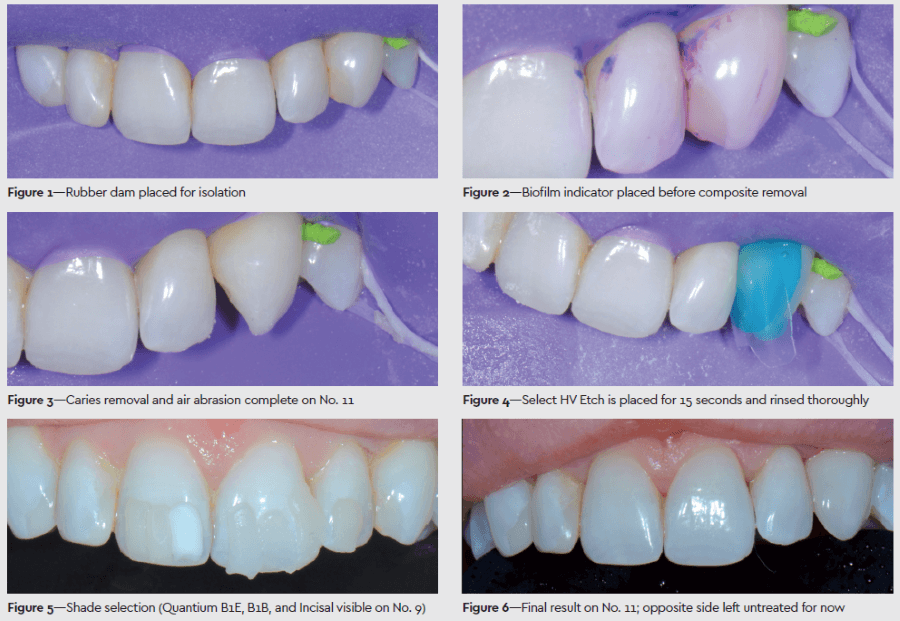
At the restorative visit, findings included recurrent decay around the existing composite margins, and the patient’s chief concern was color mismatch.
The anterior sextant was isolated with a medium-weight rubber dam and tooth No. 11 was treated with air abrasion after the old composite and caries were removed. Select HV Etch and All-Bond Universal were used for bonding, and the restoration was built with Quantium universal composite in B1 Enamel, B1 Body, and Incisal shades agreed on by the patient, along with an A1 flowable in some areas.
Occlusion was checked and adjusted as needed, and the restoration was polished, flossed, and then the final contour was evaluated with the patient’s input in an upright seated position. The patient was advised to return in 2 weeks for postop intraoral photos and any fine-tuning on the shape of the canine treated, as well as a review for the plan to restore teeth Nos. 6 and 7 in the future.
That let her take the result home, live with it, and decide whether she was happy with the color and the shape. The immediate postop photos work in our favor here: You can see the treated side, where the match came out very nicely, next to the untreated side in the same frame.
Why Quantium?
I currently work in a busy PPO practice, so I don’t always have the time budgeted to do multiple layers on an anterior tooth. This patient was no exception: a career professional who travels for work and wants to get in and out, but who also has high esthetic demands, doesn’t want the teeth “cut,” and wants to bill out an insurance code for maximum coverage. That’s a tough spot to deliver from as a provider.
Quantium helps because it comes in the most commonly used shades in both body and enamel, with an incisal and bleach shade. On a front tooth, the body shade carries most of the chroma while a bit of enamel shade adds translucency where needed. It’s a real perk to get that result without too much layering.
Warming Is Encouraged
I use warmed composite almost exclusively, and Quantium unit doses were cleared for warming right when they came to market. With a lot of other composites, you have to call the manufacturer or dig through the IFU to find out whether—and how—you can heat it. Quantium answered that from day one, and because BISCO is so science-driven, I trusted the research was there behind the claim.
Warming lowers the viscosity of the material and allows it to turn corners more easily and flow into all those hard-to-reach places. There’s an ergonomic benefit, too. I have a petite frame, and the decreased extrusion force needed with lower-viscosity materials (due to warming) means I don’t have to squeeze nearly as hard to get the composite where I need it. Quantium is formulated with small nanoparticles for high polishability and larger particles that impart strength—making it a great tool to have in the toolbox, especially for general dentists trying to keep things simple for their patients and their teams.